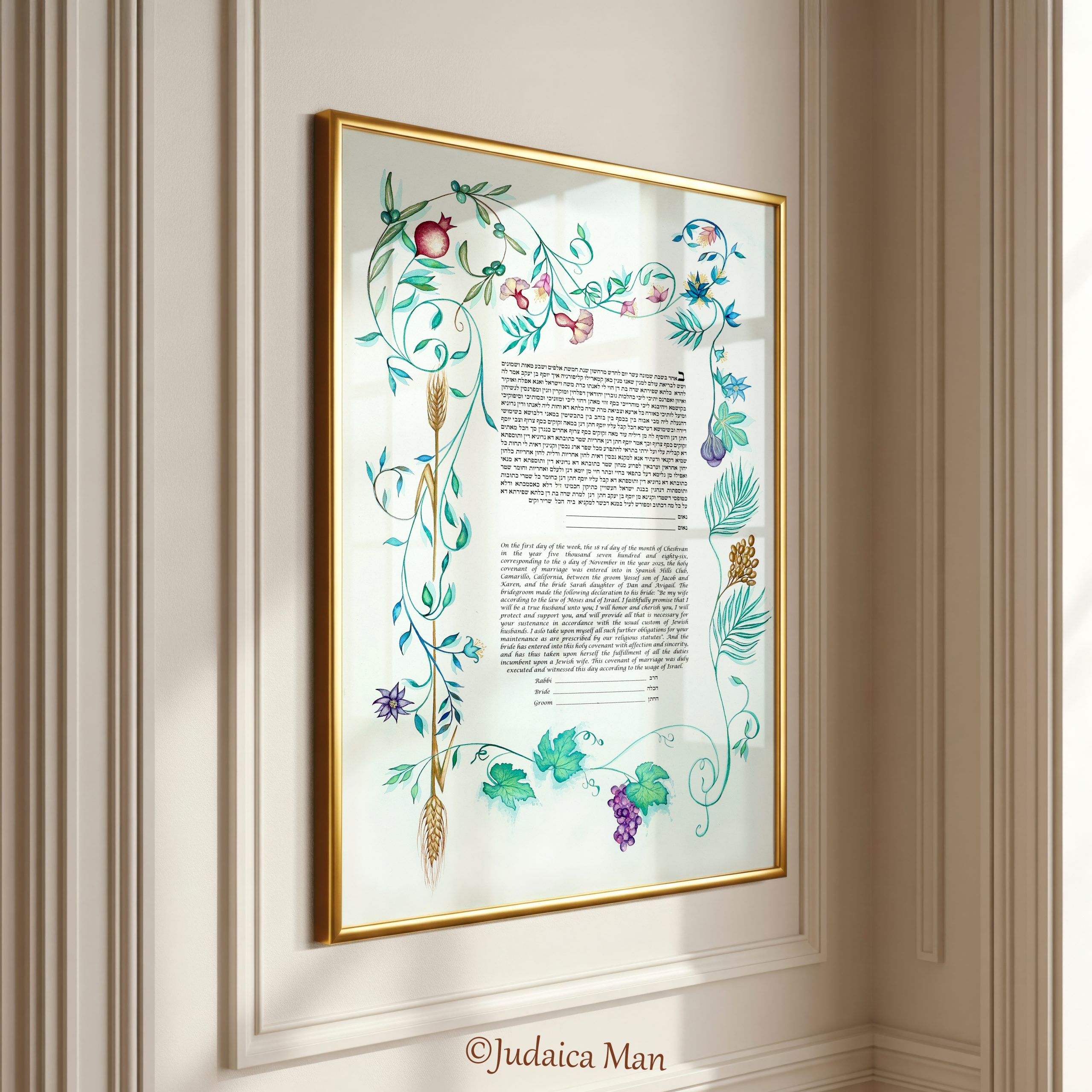
When a couple comes to us two weeks before the wedding with a PDF of a ketubah text and a photo of their living room, they’re not there to pick a “product.” They’re asking how to create one single thing that will stand beautifully under the chuppah that evening, and still hang on their wall twenty years from now without looking like an event souvenir. That’s the real question. And it’s exactly the question most pages online about ketubot don’t answer, because they’re busy showing off a gallery.
In this article you’ll find
- The difference between a printed ketubah and a hand-painted one
- Which traditional symbols and motifs can be worked into the decoration
- When it makes sense to choose real gold decoration versus faux gold
- How the ordering process works at the Judaica Man studio
- How far in advance to order, and how to preserve the ketubah for years
- A comparison table of the types of ketubot you can order
Table of Contents
- What is a decorated ketubah, and how does it blend tradition with Jewish art?
- What are the advantages of a hand-decorated ketubah over a printed one?
- What characterizes a classic decorated ketubah, and who is it suited for?
- When is it worth choosing a gold-decorated ketubah, and how is gold leaf applied?
- How does the creative process work at the Judaica Man studio?
- How far in advance should you order a custom-designed ketubah?
- Is it permitted to hang a decorated ketubah at home, and how do you preserve it?
- Which type of ketubah suits you?
- What to prepare before contacting us
Featured Products



What is a decorated ketubah, and how does it blend tradition with Jewish art?
A decorated ketubah is the traditional marriage document, complete with its full halachic text, surrounded by and interwoven with handmade artwork: illustration, framing, Hebrew typography, and Jewish symbols. It serves two purposes. First, under the chuppah, as a signed and read document. Second, at home, as a hanging work of art.
This tradition is ancient. Ketubah decoration developed within Jewish communities as a branch of the art of illuminating Jewish manuscripts, alongside Scrolls of Esther, Passover Haggadot, and illustrated prayer books. In 17th-century Italy, ketubot were decorated with rich architectural frames and gold. In Persian and Afghan communities, dense frames of foliage and medallions appeared. In Holland and Morocco, entirely different visual languages developed. The same Aramaic text, dozens of visual languages.
What holds it all together is balance. The text must be entirely precise, letter for letter, according to the community’s custom and as approved by the officiating rabbi. The decoration, on the other hand, is where beauty for the sake of the mitzvah comes in. We don’t beautify the mitzvah for the photos. We beautify it because that’s how it should be done.
Traditional symbols and motifs in ketubah decoration
The Seven Species, Jerusalem, the Tree of Life, pomegranates, delicate foliage, and verses from Song of Songs or the wedding blessings. These are the motifs that come up again and again in our workshop, and each one carries its own weight. A pomegranate for the mitzvot, a tree of life for the Torah and the family branching outward, a Jerusalem gate for the longing.
How do you choose? We ask one simple question: what’s the thing that would tell your story without words. A couple who met on a trip to the Galilee asked us for olive branches and native Israeli iris in the margins, with no Jerusalem at all. A bride whose grandmother came from Marrakesh asked for a frame of Persian arches in deep tones. Both were right. A motif chosen because “that’s what’s done” stays decoration. A motif chosen because it’s yours becomes a story you’ll tell your children.
What are the advantages of a custom hand-decorated ketubah over a printed one?
A hand-decorated ketubah is one of a kind, literally. There isn’t another one like it anywhere in the world, because the hand never repeats itself exactly.
With real watercolor, the pigment sinks into the paper fibers in layers. Look closely and you’ll see depth, soft edges where the color met the water, and places where the white of the paper stays exposed and glows from within.
In terms of customization, with printing you choose from what already exists. With a custom-designed ketubah, you can set the color tones to match the bride’s bouquet, fit the exact dimensions to the spot you’ve already marked on the living-room wall, and add a personal element that no one but the two of you will understand. A couple ordering a custom hand-decorated ketubah can ask us to work in, along the margin, the flower that grows in the parents’ backyard, at a height of two centimeters. No guest will notice. But the couple will, they’ll see it every day.
And there’s a third thing that’s hard to measure. The ketubah is made while you’re in the middle of the preparations, in the middle of the stress, in the middle of the joy. It’s created for you in real time, and that feels different.
What characterizes a classic decorated ketubah, and who is it suited for?
A classic decorated ketubah is built on symmetry. A frame in a traditional gate style, columns or an arch at the top, restrained and regal coloring of deep crimson, midnight blue, olive green and gold, and a central text that breathes rather than being crowded by the ornamentation.
The guiding principle of this style is that the decoration serves the text, not the other way around. Rich margins, a clean center. That’s the exact opposite of modern ketubot with very geometric illustration.
Who is it for? Couples who want something timeless. If you’re looking at design styles and asking yourself whether it will look dated in a decade, classic is the safe answer. It fits a minimalist modern living room just as well as a home with heavy wood furniture, because it isn’t trying to be a trend. We saw this with a couple who’d moved into an entirely white, Scandinavian-style apartment. The classic ketubah with gold was the one warm thing on the wall, and it made the whole room.
Combining traditional calligraphy into the classic design
The Hebrew letter is the heart of the classic look. Careful calligraphy, whether in Ashurit script or in Sephardic or Italian script, gives the text a weight no digital font can match. In the studio we work with calligraphy nibs at different angles, and the subtle variation in stroke thickness is what creates the rhythm on the page.
Bilingual is also possible. Hebrew and English, Hebrew and French. We know how to blend the two languages harmoniously on the page.
When is it worth choosing a gold-decorated ketubah, and how is gold leaf applied?
Gold is right when you want the ketubah to respond to light. That’s the key difference between it and any other color: it isn’t a flat color, it’s a reflective surface that changes depending on the time of day and where you’re standing in the room. In the morning it’s quiet; in the evening under spot lighting it burns.
We make gold-decorated ketubot two ways. Real gold leaf, 23 to 24 karat, laid onto an adhesive base layer and burnished with an agate polishing stone until it shines like a mirror. Or high-quality faux gold, which gives an impressive effect at a lower cost. Both options are entirely legitimate. The question is how close you’ll be standing to the ketubah day to day.
Where do we place it? A gilded opening letter at the top of the text. A thin line along the outer frame. Tiny points of light within the leaves and flowers, like dew. And here it’s important to say one thing: too much gold kills the design. It should be the accent, not the sentence.
As for durability: real gold leaf doesn’t oxidize or fade, which is why Italian ketubot from three hundred years ago still shine in museums. What can happen is flaking, and that’s a fault of application, not the material. The base layer has to be applied in a thin, even coat, and reach exactly the right level of tackiness before the leaf is laid down. Too early and the gold sinks in. Too late and it won’t take. It’s a window of about twenty minutes, and it’s something you can only learn by hand.
How does the creative process work at the Judaica Man studio?
Four stages, all documented. Here at Judaica Man, you don’t receive a finished product as a surprise. You watch it come to life.
Stage one, briefing. A short questionnaire and a conversation. Which style speaks to you, which motifs, which colors, what ketubah text you need.
Stage two, sketch. We prepare an initial sketch and send it to you. You give feedback, we revise. At the same time, the text is sent to the officiating rabbi for approval. Not a single line is painted before the text is finally approved.
Stage three, the work itself. Painting, calligraphy, and gilding. Along the way we send photos and short videos from the desk. Some couples want to see everything, and some prefer to be surprised at the end. Both are fine.
Stage four, finishing and packing. A final spelling check of the names, full drying, protected packing, and shipping or studio pickup.
We’re the Judaica Man team, and we run a Judaica art studio where every piece is made by hand, from idea to finish. Israeli work, start to finish. There’s no production line, no outsourcing, and no template where only the names get swapped in. At a time when everything else about the wedding can feel like a to-do list, this is meant to be the one thing you don’t have to worry about.
How far in advance should you order a custom-designed ketubah?
Six weeks to three months before the wedding, at minimum. If you want full hand calligraphy, multiple languages, and real gold, allow three months.
Why so long? Because the time is split up. A week to two weeks go into the questionnaire, sketch, and round of revisions, and that depends both on you and on how quickly the rabbi returns text approval. After that comes the work itself, and here there are no shortcuts. Inspiration needs calm and time. A successful painting is one made with a different kind of attention each day, with patience, and above all with care for every last detail. Gold needs binding time. Calligraphy across dozens of lines of Aramaic isn’t written in one evening, and if a single letter goes wrong, sometimes the page has to start over.
And the most important point: you don’t want to be chasing the rabbi for text approval the week of the wedding. Trust us.
What to do if you’re on a tight timeline
There are solutions. You can choose a design that already exists in our gallery and just have the names, date, and location adapted. You can skip hand calligraphy and work with high-quality printed text inside an original illustration, which saves time and significantly lowers the cost without giving up the handmade decoration. Or you can simply message us on WhatsApp at 052-338-3094 and ask what’s available. Sometimes there’s an opening in the schedule, and sometimes there isn’t.
Is it permitted to hang a decorated ketubah at home, and how do you preserve it?
Customs vary. The common practice among many couples is to frame and hang the ketubah in an honored spot at home, though some halachic authorities have raised reservations about displaying it publicly, partly because the financial obligations and conditions detailed in the document are a private matter between the couple. If this matters to you, ask the rabbi guiding you. It’s a two-minute question.
In practice, couples who prefer discretion choose to hang it in the bedroom or a quiet corner of the home rather than facing the entrance.
Now, on preservation — and here we’re firm. Your ketubah is paper and pigment, and it’s sensitive to exactly the same things any work on paper is sensitive to.
Red and pink pigments are the first to fade in light, and within five years by a window you’ll see the difference. That’s why it’s important not to place the ketubah, printed or original, in direct sunlight.
A mat board (the cardboard border around the artwork inside the frame) is important but not essential. It keeps the paper away from the glass and prevents sticking and mold, especially in humid homes. Placement. Not in direct sun, not above a radiator, not on a damp exterior wall, and certainly not in a bathroom.
Which type of ketubah suits you?
The choice depends on three things: how much time is left before the chuppah, what the budget is, and how important it is to you that the letters themselves are handwritten. The table below compares the styles we actually work in.
| Ketubah Type | Who It Suits | What You Get | What to Consider | Recommended Lead Time |
|---|---|---|---|---|
| Original hand-decorated artwork with printed text | Couples who want an original painting on a balanced budget | Original watercolor illustration, uniform and legible text | The letters themselves are not handwritten | One to three months |
| Hand-decorated with Hebrew calligraphy | Those who want everything done by hand, including the lettering | Living script with varying stroke weight, the look of a traditional document | Higher cost and longer timeline | Six weeks to four months |
| Decorated with faux gold | Those who want shine without jumping a budget tier | Attractive light reflections in the frame and opening letters | The tone is slightly more uniform than real gold | One to three months |
| Decorated with 23–24 karat gold | Those who want maximum refinement and generational durability | Agate burnishing, depth, shine that shifts with the light | The highest cost, requires binding and drying time | Two months or more |
| Bilingual ketubah | Diaspora families, from France, the UK, and the US | Original text alongside a translation in balanced hierarchy | Requires careful layout planning in advance | Two to five months |
What to prepare before contacting us
The more creative room you give us and the more you engage with the ketubah questionnaire, the closer the first sketch will be to what you wanted, and the more you’ll save yourself a full round of revisions.
What helps us get started: both of your full names and your parents’ names in the exact spelling that will appear on the ketubah, the Hebrew and civil dates, the wedding venue, the ketubah text as your rabbi requires it, and a photo of the wall at home where it will hang, wedding colors, colors you love…
And one more thing almost no one thinks about in advance: what does Jewish law say, what’s permitted and what’s not, in the illustration and text layout of a ketubah? We plan for this at the sketch stage, so that the illustration and text are welcomed when they reach the rabbi for approval.
More Products Worth Knowing


Frequently Asked Questions About Choosing and Ordering a Decorated Ketubah
These are the questions that come up in almost every first conversation with a couple.
If You’re in the Middle of Planning
Write to us. You can reach us on WhatsApp at 052-338-3094 or by email at info@judaicaman.com, and you’re welcome to just ask a question without ordering anything. We’d love to hear where you’re getting married, what the home you’re building looks like, and what you’d want to see on the wall thirty years from now.
Out of love for the craft, for the people of Israel, and for the good land.
Judaica Man.