At Judaica Man, we care about every letter, every comma, every paragraph in the text of your ketubah. That is the moment a ketubah stops being a design and becomes a document. Both of those things live on the very same page which is exactly why it helps to know how to choose, before you start.
In this article, you could find:
– The difference between a printed ketubah, a custom-designed ketubah, and a hand-painted one.
– What the personalization process looks like, from your first conversation to delivery.
– What affects the price of a ketubah, and what to factor into your timeline.
– Bilingual ketubot, and how to balance the two languages.
– How to store and frame your ketubah correctly after the wedding.
– What to do if a mistake is discovered late in the process.
Table of Contents
1. What is a custom designed ketubah, and why do couples choose one?
2. Who is a custom ketubah for, and how do different couples’ needs differ?
3. Printed or hand-painted? The difference you notice up close
4. “Illustrated” and “hand-painted”: two words, two different things
5. What personalization actually involves
6. What hand calligraphy adds, compared to a font
7. What makes up the price
8. When to order, so you’re not rushing at the end
9. The details you need to prepare before you begin
10. Two languages on one page, without the clutter
11. How to choose a style that will still look right in twenty years
12. Checking quality: what to ask about materials
13. The remote ordering process, step by step
14. A mistake was found a week before the wedding now what?
15. Framing and preserving your ketubah after the wedding

1. What is a custom-designed ketubah, and why do couples choose one?
A custom designed ketubah is the very same ketubah read under the chuppah it simply carries an additional layer of art: illustration, ornamentation, framing, calligraphy. The text stays the text; the page becomes a work of art.
This custom is ancient. In seventeenth-century Italy, ketubot were decorated with painted marble columns and biblical figures; in Persia and Afghanistan they were adorned with geometric Islamic motifs; in Morocco, artists favored rich color and dense calligraphic script. This was never a luxury it was “Zeh Eli ve’anvehu- זה אלי ואנוהו”, beautifying a mitzvah while fulfilling the mitzvah of bringing joy to the bride and groom.
The practical reason couples choose a custom ketubah is simple: after the wedding, it stays. At Judaica Man, we design every piece with the understanding that it will hang on a living-room wall for twenty years not sit folded in a drawer. That single fact shapes every decision along the way.
A custom-designed ketubah preserves the halachic text and adds an artistic layer that remains in the home for many years after the wedding.
2. Who is a custom ketubah for, and how do different couples’ needs differ?
Every couple married according to halacha (jewish law) receives a ketubah. The only real question is: which one?
Religious and traditional couples who come to us almost always know exactly what text they need “according to the law of Moses and Israel,” in the wording of a specific community, and sometimes their rabbi has already sent us a prepared file. For these couples, the design is built entirely around the sacred text, without touching a word of it.
More traditional or secular couples with a connection to the tradition sometimes arrive with different questions: Can we add a verse we love? Can the dedication be in French, because Grandma’s side of the family doesn’t read Hebrew? The answer is usually: Yes, as long as the requests are consistent with Jewish law and approved by the officiating rabbi.
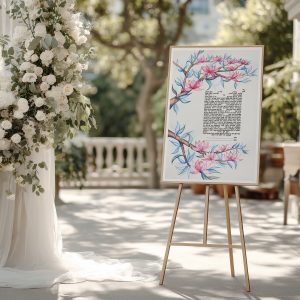
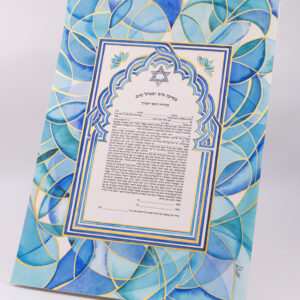
A custom ketubah is, ultimately, a flexible tool. Some couples come from communities in the north and ask for a purely natural design like branches, leaves, fruit, olives, grapevines, the Seven Species. Others lean more traditional like a Parisian couple, who asked for a Persian mandala ketubah. And some couples like a modern style and want something abstract, minimalist, or richly colored. Every one of them ends up with a ketubah that looks unmistakably like theirs.
The halachic text (arameic text) is set by the couple’s community and rabbi, the design shapes itself around that text without ever touching the binding core.
3. Printed or hand-painted ketubah? The difference you notice up close.
Good printing today means fine art printing at a print house that specializes in reproducing artwork and lithography. An existing design is scanned, printed with an extensive range of pigments on 100% cotton, acid-free paper, and the result is clean, consistent, and a precise reproduction of the original. It’s a solid option for couples who want something beautiful on a shorter timeline or a more accessible budget.
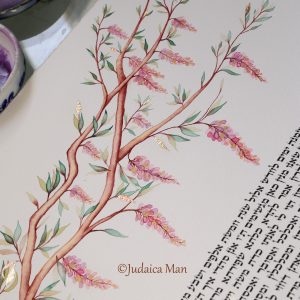
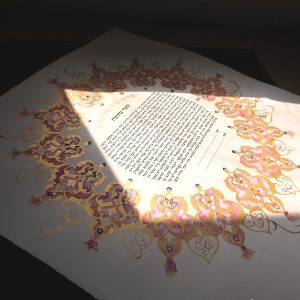
A hand-painted ketubah is an entirely different story. In the studio, we paint in real watercolor, layer upon layer, and the pigment settles inside the fibers of the paper rather than sitting on top of it. An 24 karat gold leaf is laid and burnished by hand, which is why it catches the light differently depending on the angle and shifts as you move through the room.
The biggest difference is that no two are ever alike. Order the exact same concept twice, and you’ll receive two different works.
| Parameter | Printed Ketubah | Custom‑Designed Ketubah | Hand‑Painted Ketubah | Handwritten Ketubah |
|---|---|---|---|---|
| Appearance | Uniform and clean | Tailored to the couple | Original painting, acrylic layers | Artistic letters with variable pressure and weight |
| Level of Personalization | Medium | High | Very high | High |
| Production Time | 2–4 weeks | 1.5–3 months | Up to three months | Depends on writing scope |
| Uniqueness | Can be duplicated | Limited | One of a kind | One of a kind |
| Suitable For | Short timeline, focused budget | Couples who want “ours” | Couples who want a piece of art | Couples who love beautiful, artistic handwriting |
The difference between printing and original painting lives in the details, in the watercolor layers and the hand-burnished gold leaf.
4. “Illustrated” and “hand-painted”: two words, two different things
These terms get mixed up in the market, and sometimes it costs couples more than they expect.
An “illustrated” ketubah simply means it contains an illustration. It doesn’t promise that the illustration was created specifically for you it could be a digital illustration that was printed, or a catalog ornament colored on a computer. A hand-painted ketubah means someone sat at the paper with a brush.
An illustrated ketubah isn’t necessarily a handmade one and one direct question to the artist will clear that up quickly.
5. What personalization actually involves
At Judaica Man we start with a conversation by video or whatsup, not a catalog. Together, we go through a detailed questionnaire to find your taste. We ask where the chuppah will be, what’s the palette color of the Chuppah, what colors are in the living room the ketubah will hang in, and whether something recurs in your story a color, sometimes a fig tree in a grandfather’s yard, sometimes a bird the bride has been drawing since she was six.
Motifs that come up often in our studio: the Jerusalem skyline, the Tree of Life, pomegranates, the Seven Species, almond branches in bloom, and delicate geometry inspired by Moroccan ketubot. The studio leans toward architectural line work alongside botanical and gold ornamentation.
After the conversation comes a sketch. The sketch is a deliberate pause point, this is where things get changed, moved, or dropped if an element feels too busy, and only after it’s approved do we touch real paper. At Judaica Man, we never start painting without written sign-off on both the sketch and the text. A custom ketubah is built this way: slowly, and with care and love.
Personalization begins with a conversation about your home, and continues through a sketch that is approved in writing before anyone touches the paper.
6. What hand calligraphy adds, compared to a font?
A font is identical letters. Calligraphy is letters that breathe.
The pen gives each stroke a different weight, the letter thickens on the downstroke and thins on the upstroke and the page carries a rhythm you feel before you even read it. Look at an old Yemenite ketubah, or rounded Spanish script, and that rhythm is exactly what catches the eye. A ketubah with hand-lettered calligraphy looks entirely different from one that isn’t.
Choosing hand calligraphy for your ketubah gives every word a presence a computer can’t reproduce. It’s also the part that demands the most care, because a letter, once written, is already there.
Which parts are typically done by hand?
There are three approaches. The first: the entire text, fully hand-lettered.
The second: the text printed with archival pigment printing, with the couple’s names, date, and location filled in by hand.
The third: a large calligraphic heading above a printed text. Couples who choose the middle option usually do so for timeline reasons and reasonably so.
Hand calligraphy adds a rhythm and presence that no font can reproduce — but it demands great care, since every letter is written only once.
7. What makes up the price?
We get asked about this in the very first conversation, so let’s be direct. The price of a custom ketubah is built from several layers that stack on top of one another.
Full hand-painting versus printing is the biggest gap of all, since an original watercolor painting can take days, sometimes weeks. 24K Gold leaf adds both material cost and time, because laying and burnishing it can’t be rushed. Full calligraphy adds many hours of work. A second language changes the entire page layout, not just the amount of text. A larger size doubles the painted surface, and a more elaborate frame is priced separately.
A custom ketubah is a one-time expense on a single day, and it stays on the wall longer than almost anything else you bought for the wedding. That’s the perspective we like to offer couples, with no pressure attached.
The price is built from the time and difficulty of the hand-painting, gold, calligraphy, a second language, and size rather than one fixed rate.
8. When to order ? so you’re not rushing at the end
For an original hand-painted piece: three to four months before the chuppah.
For a customized print: three to four weeks. These aren’t conservative numbers added out of caution, they’re the numbers that actually play out.
The time breaks down like this: the conversation and gathering details, the sketch, a round of revisions and approval, the text checking, and then the painting itself. A hand-painted ketubah needs drying time between watercolor layers, and gold leaf needs to settle before it’s touched again. After completion comes a final check, packing, and shipping.
Ordering during a busy season like summer adds another two weeks of buffer. If your wedding falls in Elul (September- October), talk to us by Tammuz (June- July) at the latest not Av (Agust).
An original hand-painted piece needs two to four months’ notice, and busy seasons call for an extra two weeks on top of that.
9.The details you need to prepare before you begin
Most delays in our work aren’t caused by the painting. They’re caused by a missing detail. Before we started working on ketubot, we studied together with a Sephardic Rabbi (Rav yosef Chaim Habbah) and an Ashkenazi Rabbi (Rav Daniel Kohn) about all the halachically valid texts and their precise wording. That’s why it’s important to us that there be no mistake whatsoever in the text, since we are meticulous about the kashrut (halachic validity) of the text as Jewish law requires. And therefore, here’s what’s essential: the groom’s full Hebrew name and his father’s name, the bride’s full Hebrew name and her father’s name, the Hebrew and civil date, and the name of the city or town where the chuppah is taking place. One question many people miss: does the chuppah take place before or after sunset? Because after sunset, the Hebrew date has already advanced by a day. For that reason, we always recommend confirming the text with the officiating Rabbi first, and only then sending it to us. In many cases, Rabbis actually prefer to leave certain fields blank and fill them in on the day of the chuppah itself, to avoid distress if the ceremony is delayed.
Checklist to send the studio:
The community’s text tradition you need: Ashkenazi, Sephardic or a combined text approved by the Rabbinical consul (such as a Tzohar text). The precise spelling of any less common names: Jacqueline, Yehonatan versus Yonatan, or a double name. A second language, if you’d like one, including the exact foreign spelling. The name and number of a single point of contact who will approve the sketch, so we’re not receiving three conflicting versions from four family members. And yes, it genuinely helps to send us a photo of a parent’s ketubah, if one exists, more than you’d expect. A custom ketubah begins with these details.
A precise text filled by your Rabbi saves delays later in the process.
10. Two languages on one page, without the clutter
Many of our clients come from France, England, and the United States, and this question comes up in almost every conversation with a family from the Diaspora.
The correct halachic solution is: the Aramaic text is placed at the top of the page, with the translation beneath it. The witnesses sign below the Aramaic section.
Our rule when building a bilingual, illustrated ketubah is simple: uphold Jewish law, and blend the two languages evenly on the page. A hand-painted custom ketubah is built to hold both together.
In a bilingual ketubah, Aramaic leads according to halacha (the Jewish law) and also so the page doesn’t feel crowded.
11. How to choose a style that will still look right in twenty years?
If one couple came to us asking for a ketubah in antique pink and copper tones, because those were their wedding colors. Levia’s question back will be: what color is the sofa in your living room? That’s the real test of a ketubah designer’s experience.
A ketubah doesn’t just need to suit the venue. It needs to suit the wall of your new home. Take two or three main colors from your own home, no more, and build around them. Nature motifs, delicate geometry, and ornamentation inspired by antique ketubot age beautifully, because they’ve already survived several centuries.
What ages quickly: trendy typography, a season’s particular pastel palette, and illustrations that mimic whatever style is everywhere right now. At Judaica Man, we lean classic and natural, not out of conservatism, but out of experience. What looks the most exciting on the sketch is usually what tires the eye fastest after two years on the wall.
Choose colors based on your home, not just your wedding’s palette because the ketubah will hang in your living room, not at your wedding.
12. Checking quality: what to ask about materials?
The paper matters more than anything else. We work on acid-free, fine-art-grade cotton paper, because paper containing acid yellows within just a few years and that yellowing can’t be reversed.
For prints, ask whether they use light-fast pigment ink rather than dye-based ink. The difference becomes obvious after five years in a room with a window. For a hand-painted ketubah, the question is the quality of the watercolor pigments there’s a real difference between artist-grade pigments and classroom-grade paint. At Judaica Man we use the best pigmants in the world from France and Japan. For gold, ask whether it’s genuine gold leaf or metallic paint, since metallic paint oxidizes and darkens over time unless it’s sealed in an airtight frame which also requires knowing how to handle it correctly.
Acid-free cotton paper, pigment ink, and genuine gold leaf are the three tests that determine whether a ketubah will still look beautiful in twenty years.
13. The remote ordering process, step by step
Where mix-ups happen most often:
Spelling foreign names in Hebrew: Joel versus Jouel, for example. Calculating the Hebrew date when the chuppah takes place after sunset. And page size: a ketubah that’s too large is hard to hold under the chuppah, and one that’s too small gets lost on the wall. We check all three of these on every single order.
The remote process is built from five clear steps, and written approval on the sketch is the critical moment among them.
14. A mistake was found a week before the wedding now what?
We are not responsible for mistakes from the other side, but we take them into consideration and try to help as much as possible. First, we check with the officiating Rabbi whether the error is halachically (Jewish wedding law) significant or simply a spelling issue in the ornamentation. Depending on the severity and the materials involved, sometimes it can be corrected on the spot and sometimes a new page is needed.
15. Framing and preserving your ketubah after the wedding
If you don’t remember to bring the rigid board we ship the ketubah with along to the chuppah, it often comes back from the ceremony slightly creased at the corners and full of memories. That’s why we recommend giving it to a parent ahead of time, along with the archival-ink pen, so they can look after it and remember to bring everything that’s needed.
And now, it’s time to frame it properly.
Three things matter. Glass or acrylic with UV filtering, because sunlight fades pigments even through a window. An acid-free matboard spacer that keeps the paper away from the glass otherwise moisture gets trapped between them and the paint sticks to the glass. And an archival, sealed backing board and not ordinary corrugated cardboard, which leaches acidity over time.
Where to hang it: an interior wall not facing a south-facing window, not above a radiator, and not in a bathroom. A living room or a central hallway is the natural spot. Some couples hang it facing the entrance, so it’s the first thing they see walking in the door.
UV-filtering glass, an acid-free spacer, and an archival backing, on an interior wall that’s what keeps a ketubah beautiful for years.
If you’d like to talk about a ketubah of your own, we’re here.
WhatsApp: +972 52-338-3094
or email: info@judaicaman.com.
At Judaica Man, every piece is made entirely by hand, from the first idea to the gold, out of love for the craft and for the good Land of Israel.
#Frequently Asked Questions
Two to four months before the chuppah, how much you can before the wedding! In busy seasons like Elul (September), it’s worth adding another two weeks. That time is needed for the sketch, approval, the watercolor painting itself, and burnishing the gold leaf.
An illustrated ketubah simply has an illustration on it, but it isn’t necessarily made specifically for you, and it’s often printed. A hand-painted ketubah is created with a brush and real watercolor, which is why no two pieces are ever identical.
Yes. The key rule is that the Aramaic text goes above the translation, with the witnesses signing within the Aramaic section.
We are not responsible for mistakes from the other side, but we take them into consideration and try to help as much as possible. We first check with the officiating Rabbi whether it’s a halachically significant error or a spelling mistake in the ornamentation. Depending on the severity and materials, it can sometimes be fixed locally and sometimes a new ketubah is needed…
Frame it with UV-filtering glass or acrylic, an acid-free matboard spacer, and an archival backing board, and hang it on an interior wall, away from direct sunlight and moisture.
Choosing a ketubah means choosing a piece of art that will stay on your wall for many years, not just a detail for one wedding day, but a lasting memory of a day of love and joy for a lifetime together. At Judaica Man, we’re honored to walk with you from that first conversation all the way to the moment it’s hung in your home.