There’s one moment I love especially in this work. It’s the moment the client holds in their hands a piece that, just a minute earlier, was only an idea on paper, and says quietly, “This is exactly what I was looking for to give them.” Not a gift that gets unwrapped, politely thanked for, and disappears into a drawer. A gift that will hang on the living-room wall of a young couple and stay with them for twenty years. Here at Judaica Man, we see that difference every day, and that’s why when we talk about Judaica gifts, we’re not talking about decoration. We’re talking about an anchor. About an object that becomes part of a family’s memory, part of the home, part of the story that’s told inside it.
An interesting Israeli study that looked at the difference between buying for ourselves versus buying a gift for someone else found that we place a higher value on the time and thought we invest when we choose for someone we love. You can read about it in research on the value of time in gift selection, and it essentially puts academic words to something every artist already knows by intuition: the thought shows. When the recipient feels that you made an effort, that you deliberated, that you chose something that speaks specifically to them, the gift takes on an entirely different weight. And that’s the exact opposite of a generic gift basket that can be put together without a second thought.
In this article you’ll find
- What makes a Judaica gift meaningful — beyond symbolism
- How to match a piece to the occasion — wedding, housewarming, holiday, bar/bat mitzvah
- The difference between a useful gift and a symbolic one, and how to choose
- How to spot quality handmade Judaica versus a generic product
- How to match a Judaica piece to a home’s design style
- What to check before buying online and how to order a custom piece
Table of Contents
- What makes a Judaica gift truly meaningful?
- How do you choose Judaica gifts that fit the exact nature of the occasion?
- Which Judaica gift is best for a wedding?
- Which Judaica gifts suit a housewarming?
- Which Judaica gifts suit a young couple?
- What’s the difference between a useful Judaica gift and a symbolic one?
- What is a designed mezuzah case, and why is it so functional?
- What is a home blessing, and why is it one of the most sought-after gifts?
- What is a designed hamsa, and who is it a meaningful gift for?
- Which Judaica gifts suit a woman?
- How do you choose handmade Judaica rather than a generic factory product?
- What’s important to check before buying designed Judaica online?
- How do you match a Judaica gift to a home’s overall design style?
- Why do designed Judaica gifts beat any other generic gift?
Featured Products
What makes a Judaica gift truly meaningful?
The short answer: a Judaica gift combines three things almost no other gift manages to bring together. Deep traditional symbolism, a real design presence in the room, and use that repeats itself in everyday life. Candlesticks lit for Shabbat candles every single week. A blessing hanging opposite the entrance that’s seen every morning. A mezuzah case that everyone passing through the doorway touches. These aren’t objects that stand off to the side. They live inside the home.
The National Library published research on the Jewish home as a symbolic structure, and the idea that emerges from it is simple and beautiful: a home takes its identity from the objects and rituals inside it. When you bring a piece of Jewish art into a home, you’re not just hanging a picture. You’re redefining the space, saying who lives here and what matters to them. That’s exactly why designed Judaica pieces are a gift with Jewish meaning built in, with no need to explain it. The meaning is written into the piece itself.
How do you choose Judaica gifts that fit the exact nature of the occasion?
Our first rule is simple: don’t choose a piece, choose an occasion. A wedding, a housewarming, an engagement, a brit, or a bat mitzvah. Each of these calls for something different, and it’s not right to give everyone the same thing. A wedding calls for a piece with presence, something that marks a beginning and deserves a place of honor. A housewarming calls for blessing and protection for the doorway and the walls. A holiday calls for something functional for the table. Gifts for Shabbat and the holidays are a world of their own, and there, function is really the heart of it.
The second consideration is closeness. What you give a sister carries a different weight than what you give a coworker. The warmer the relationship, the more you can go for special, personal Judaica gifts — ones you can even order custom, with a name, a date, or a verse the couple loves.
Matching by family occasion
A couple who just moved into their first apartment needs something that builds the home. An anchor piece to start designing around. A milestone birthday or the birth of a child, on the other hand, calls for something small and emotional. A personal keepsake, something delicate, something that touches the heart more than it fills a wall. A couple celebrating thirty years together, whose home is already full, doesn’t need another large piece. They need something that says “we were thinking of you” without adding noise to the space.
Matching by the recipient’s personality
Some people’s homes burst with color — eclectic, warm, full of objects from life. For them, give a colorful blessing, a hamsa rich with gold ornamentation, a lively watercolor. And then there are the lovers of clean, Scandinavian lines, whose home lets every single piece breathe. For them, go with quiet tones, cream and stone, simple shapes. The same verse can look completely different in these two homes, and that’s the magic of handmade work. We match the piece to the person, not the other way around.
Which Judaica gift is best for a wedding?
A wedding is the start of a journey, and a good Jewish wedding gift should accompany the couple along the way, not just on that one day. We always recommend thinking about a piece that will build memories with them. Something that a decade from now they’ll look at and remember who gave it and why. Designed Judaica pieces work beautifully here, because they connect holiness with design and create a sense of belonging in a home that’s still being built.
The pieces couples most often choose to give the bride and groom are a mezuzah case for the front door, Shabbat candlesticks, and a blessing for the living-room wall. Among these, a classic piece many love to give the new bride is the Kalah bride mezuzah case in cream, which literally symbolizes the first step into a shared home. Jewish gifts for couples work best when they’re personal, so if you have the time, it’s worth ordering a custom piece with the couple’s names and wedding date. That turns a beautiful gift into their gift.
Which Judaica gifts suit a housewarming?
When a family moves into a permanent home, there’s something bigger going on than just boxes and a set of keys. It’s a move into a place that’s about to become a home. Tradition doesn’t stay indifferent to this moment. Torah sources on housewarming explain beautifully how moving into a new home connects to holiness, blessing, and opening a new chapter of life with meaning. Affixing the mezuzah and the wishes for abundance are the heart of that moment.
This is exactly where a housewarming gift that blesses and protects comes in. A designed home blessing for the living-room wall, a hamsa for the entrance, a quality mezuzah case for the front door. These are new-home gifts that speak the language of the new place from the very first moment, accompanying the hosts as they open the door to guests.
New-home gifts with design presence
If you want a piece that will take center stage and draw the eye at first glance, think about illuminated calligraphy or a large wall artwork. In our studio, we work a lot with a combination of Hebrew calligraphy, watercolor, and 24-karat gold ornamentation, and a blessing like that on the entryway wall becomes the home’s very first point of view. In the kitchen, go small and cheerful; in the living room, go big and striking. One principle applies either way: the piece should lead the eye, not hide from it.
Which Judaica gifts suit a young couple?
Young couples in a rented or small apartment are looking for something that connects to heritage without weighing down the space. A good Jewish couple’s gift for them is one that fits easily among furniture that may change, doesn’t need a whole wall, and still has character. Our experience shows that young couples are drawn to clean geometric lines, the natural textures of ceramic and stone, and soft pastel colors that go with almost anything.
A must-have piece a whole room can be designed around is the Shema mezuzah case in cream, which brings warm, earthy, understated tones to doorways without shouting. Modern-design Judaica, of the kind that’s meaningful designed pieces, is exactly the bridge young couples are looking for between the home they grew up in and the home they’re building now.
What’s the difference between a useful Judaica gift and a symbolic one?
This is the dilemma I hear most in the studio. Give something that gets used, or something that gets hung up and admired? There’s no single right answer here, just a good fit. A useful gift, like Shabbat candlesticks or serving pieces, enters life through action. Every candle-lighting. A symbolic gift, like a wall blessing or a hamsa, enters through presence and message. Often, special Judaica pieces manage to be both at once, and that’s what makes them truly unique Judaica pieces.
| Piece | Best for | Key advantage | Nature of the gift |
|---|---|---|---|
| Designed home blessing | Housewarmings, couples, families | Inspiring wall presence | Symbolic and decorative |
| Designed mezuzah case | New offices, new homes, upgrades | Immediately links holiness with the entryway’s architecture | Functional and symbolic |
| Designed hamsa | Holidays, business gifts, small gifts | Versatile, brings wishes for success | Symbolic and decorative |
| Designed candlesticks | New brides, Shabbat hosts, engagements | An active piece on holy days that creates a calm atmosphere | Functional and ritual |
What is a designed mezuzah case, and why is it so functional?
The mezuzah case protects the holy scroll inside it from sun, dust, and moisture. But it’s far more than technical protection. It’s the home’s aesthetic calling card right from the doorway. Before you even step inside, you see it. The Lexicon of Israeli Culture describes beautifully how the mezuzah serves as a symbol of identity and protection at the entrance of the Jewish home, and that’s exactly the visual expression a designed mezuzah case gives it.
Because it lives on the doorpost, sometimes exposed to the outdoors, the finish and material are critical. A designed mezuzah case for an exterior door that takes sun and rain needs different durability than one for an interior door to a children’s room. We work with materials that last for years and with tones that blend into the plaster near the door. Designed Judaica ritual objects are the corner where design for the Jewish home meets real function, and the mezuzah case is the perfect example of that.
Who a mezuzah case suits as a gift
A mezuzah case is an almost always-winning gift, because every Jewish home has doorways. It suits a couple getting married, a family moving apartments, a coworker opening a new office. Arriving in beautiful packaging, it becomes a gift that accompanies the guest from outside in, and once it’s affixed to the doorpost, it stays there for generations.
What is a home blessing, and why is it one of the most sought-after gifts?
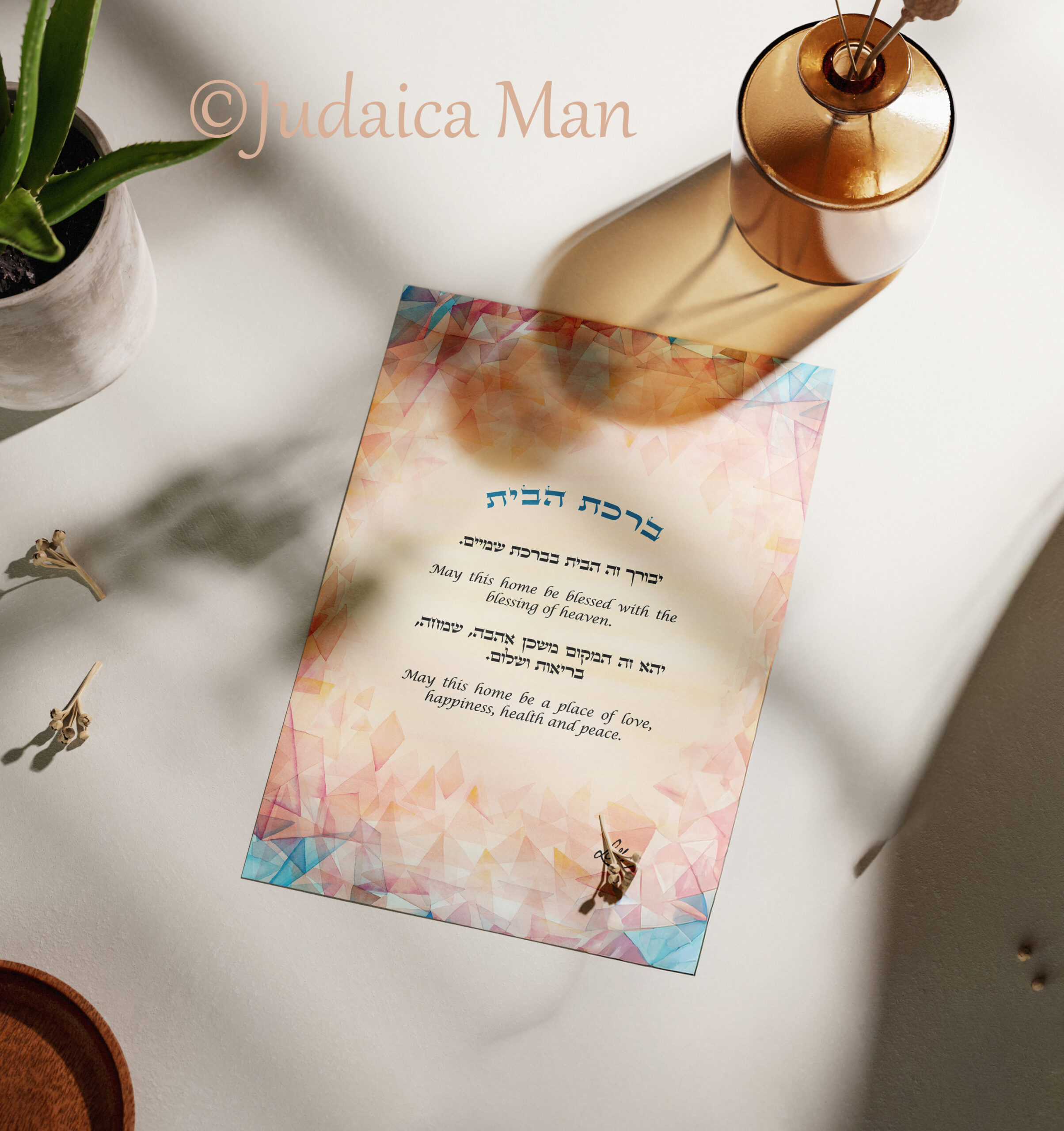
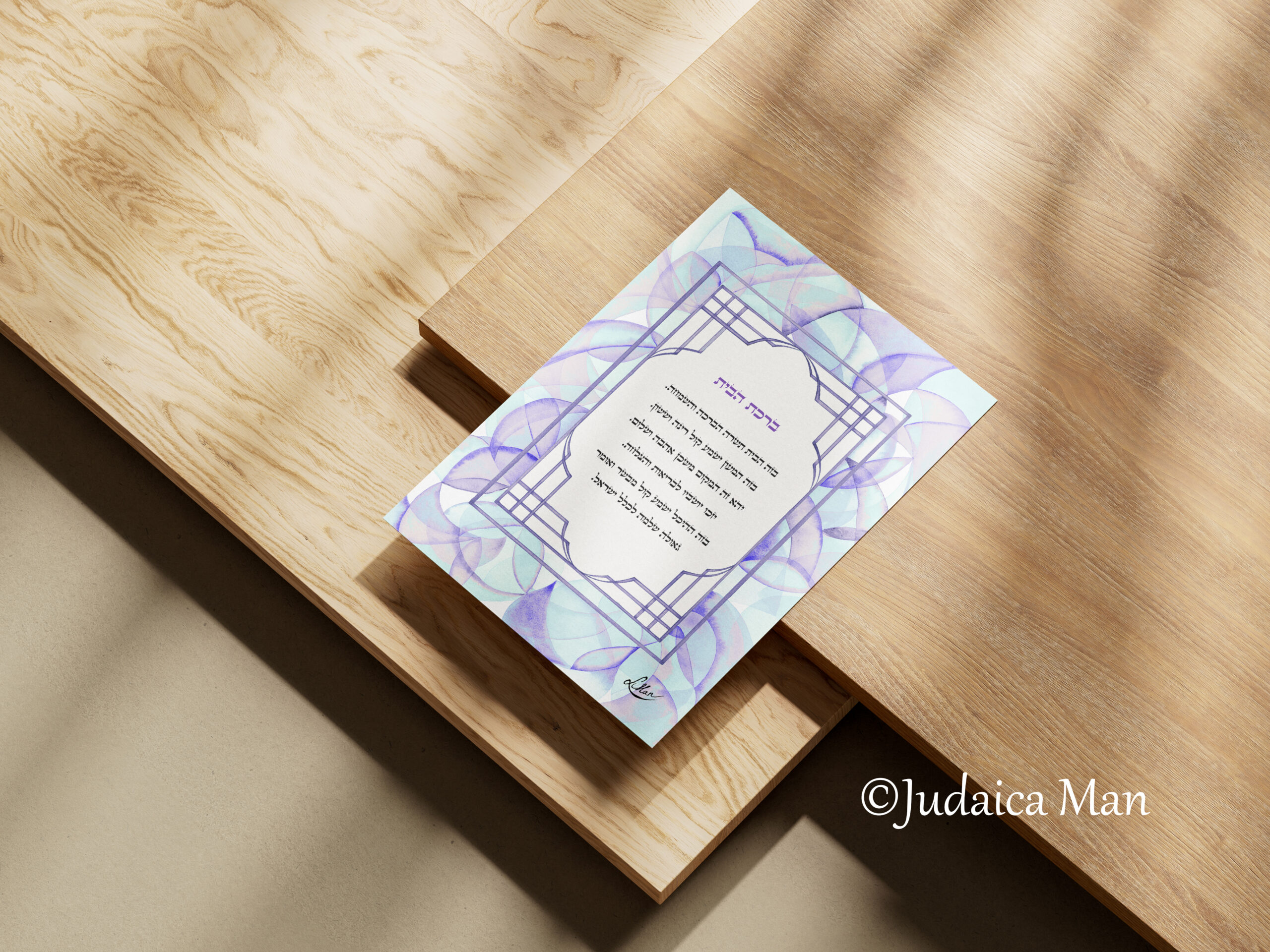
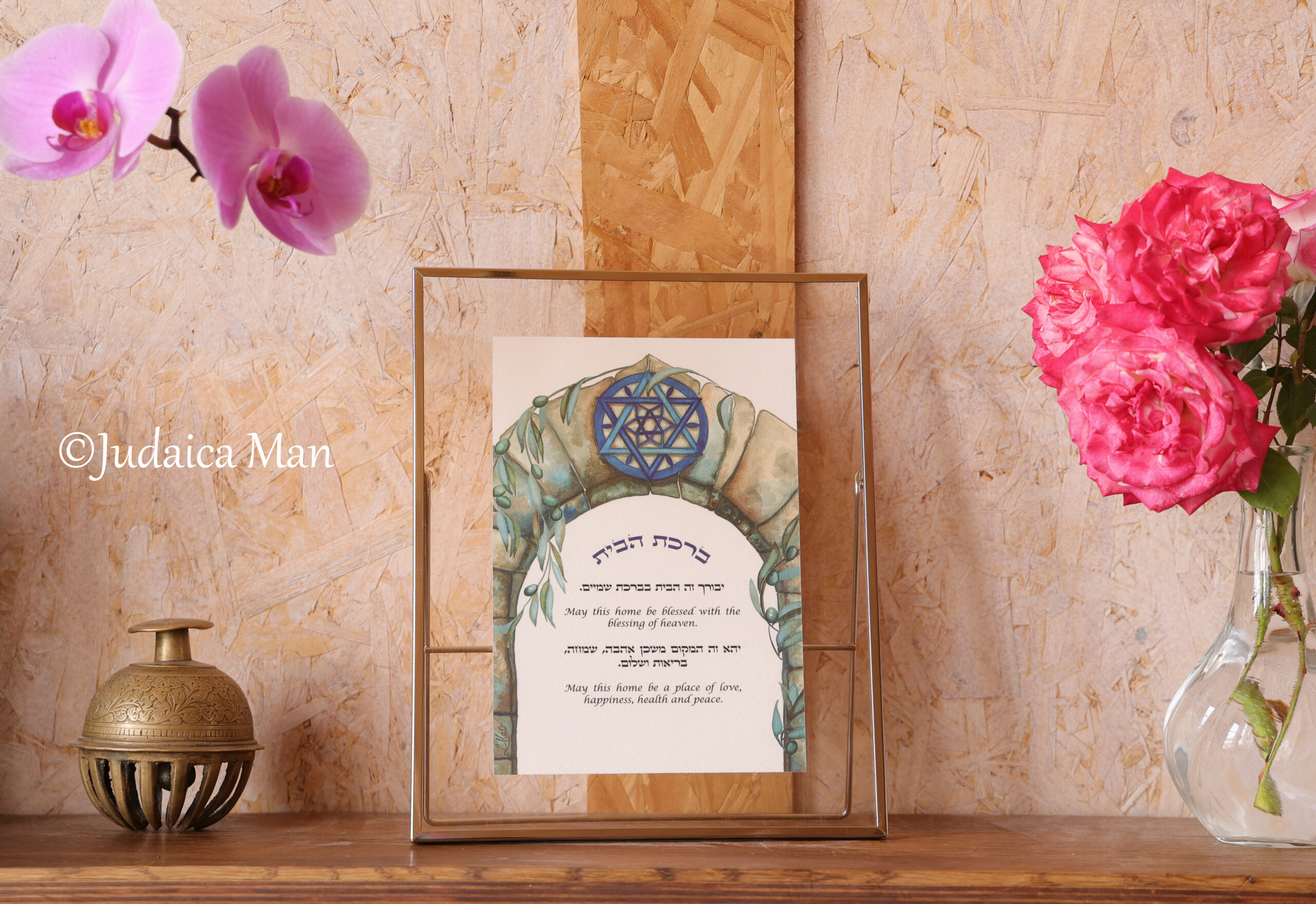
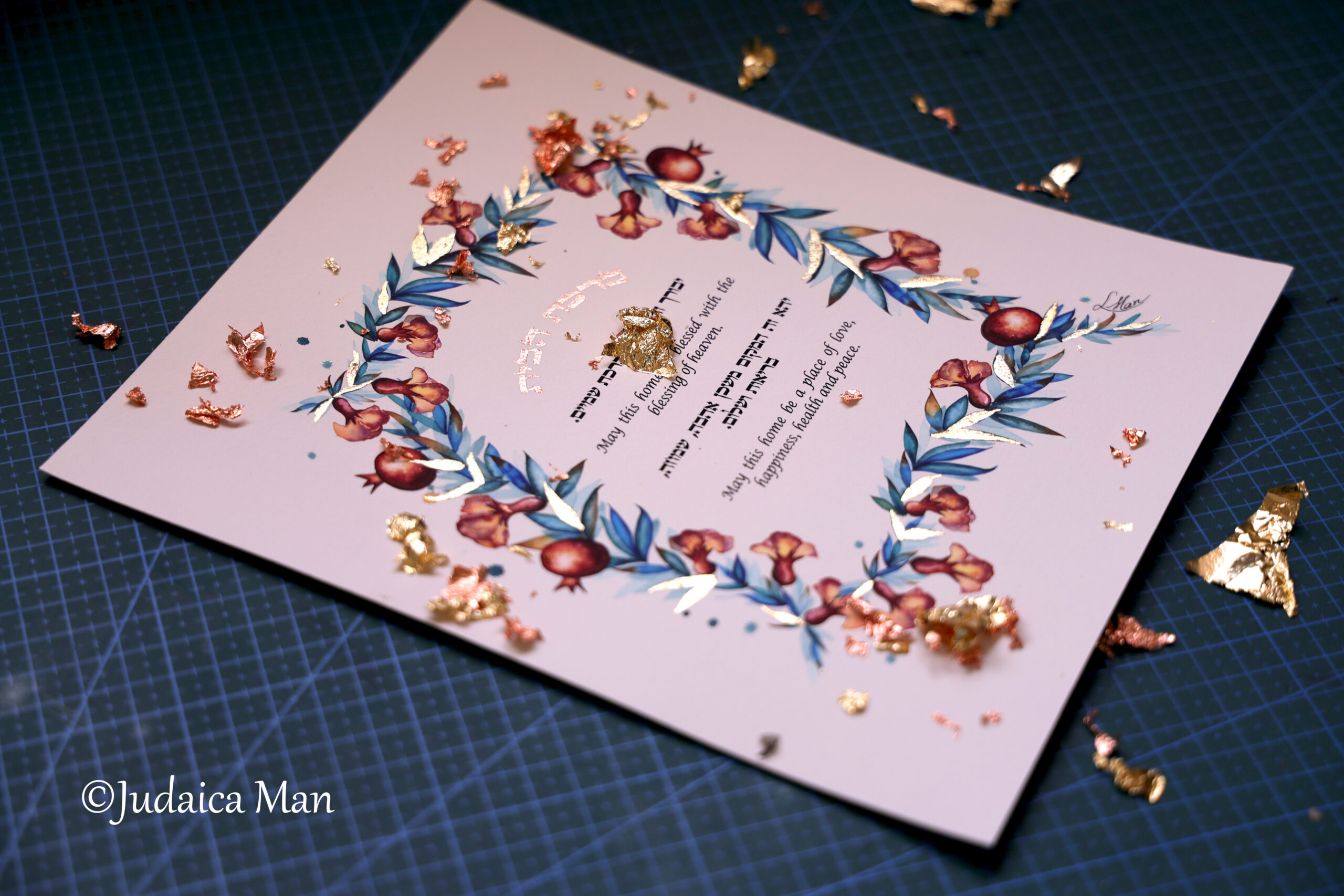
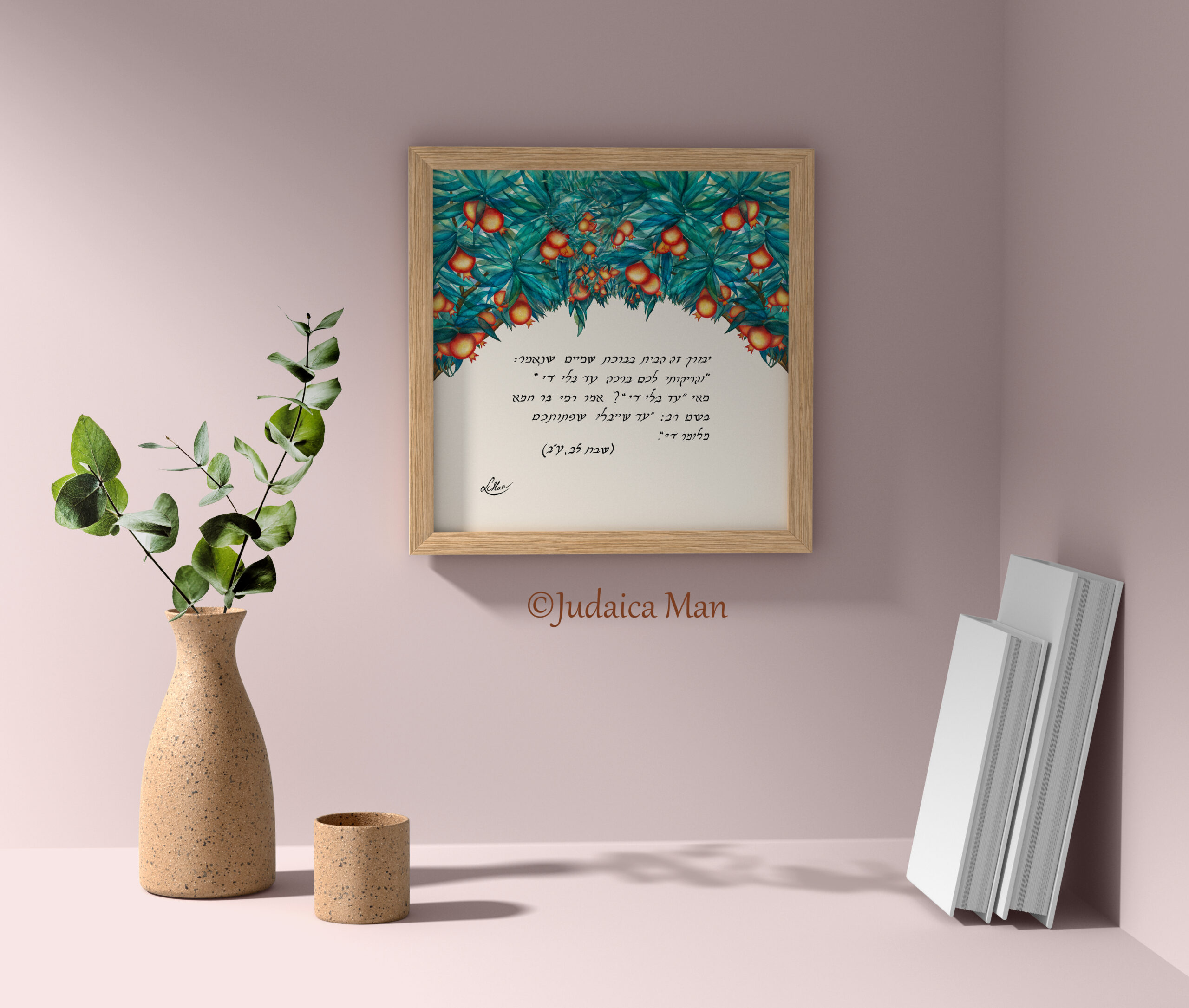
There’s power in the written word. A home blessing, with words of abundance, health, love, and peace, hangs in a central spot and becomes a quiet prayer that lives on the wall. In our workshop, we don’t settle for just the text. Levia treats every blessing as a piece of calligraphy art, with watercolor, gouache, and sometimes gold ornamentation, so the familiar words take on a depth you haven’t seen before.
This is exactly where Jewish wall art that’s also a gift with real emotional value comes in. When we talk about art that connects sacred words with a breathtaking effect, I always think of the “Shalom with Light” calligraphy, which combines an innovative rendering of holy words with a halo of light. A designed home blessing of this kind is the reason it’s the first piece people point to when they walk into the living room.
What is a designed hamsa, and who is it a meaningful gift for?
The hamsa is one of the symbols that crosses cultures. Protection from the evil eye, a wish for prosperity and health, a symbol that has accompanied the Jewish people and the wider region for many generations. What I love about it is how many artists have reinterpreted it for this era, from the classic and traditional to the clean geometric hamsa that suits a modern home.
A designed hamsa is an ideal solution when you’re looking for a secondary gift, small to medium, with a big presence. It sits beautifully at an entryway, on a living-room shelf, or on a personal office desk. Among Judaica pieces for the home, it may be the most versatile, and as a decorative Judaica piece it gives a warm wish without taking up an entire wall.
Which Judaica gifts suit a woman?
When looking for a Jewish gift for a woman, I recommend thinking about what speaks to both the heart and the eye at once. Candlesticks with a stone-like texture that sit beautifully on the Shabbat table. A delicate “Eshet Chayil” (Woman of Valor) piece that softens a corner of the home. A designed blessing in tones she loves. A choice like that says something beyond the piece itself: that you saw her artistic sensibility, her taste, and that you made the effort to match it to her.
A handmade Jewish keepsake will always feel more personal than something off a shelf. Jewish handmade pieces carry within them the hand that made them, and a woman who appreciates beauty will feel that immediately. If you’re torn, a piece you can add a name or a beloved word to is almost always the choice that moves people most.
How do you choose handmade Judaica rather than a generic factory product?
The difference between a piece made by hand and one that came off a production mold is a difference of soul. An essay from Bezalel titled “Five Easy Pieces,” about the process of creating Judaica today, speaks precisely to that connection between material, volume, tradition, and process. When a piece passes through an artist’s hands, it retains traces of small decisions. Exactly how much gold on this letter, where the color breathes, how the line moves. A mass-produced item doesn’t know those decisions. It’s perfect and flat in equal measure.
Genuinely handmade Judaica, Judaica designed with soul, isn’t just beautiful. It’s unique. Two pieces that came from the same idea won’t be perfectly identical, and that’s the beauty of it. Here at Judaica Man, Asaf and Levia make every piece by hand, from concept to finish, and that’s craftsmanship in the fullest sense of the word.
Signs of quality handmade work
How do you spot it? Look at the finish. Authentic color with depth and layers, not a flat uniform print. Rough, stone-like texture you can feel with your fingers. Delicate engraving that doesn’t repeat itself with millimeter precision. The use of non-industrial materials like olive wood, ceramic, cast brass. At the Terra-Ba’it gallery at the Eretz Israel Museum, you can see beautifully how material and ceramic technique carry the value of local craftsmanship. When you hold a piece like that, you feel the hand. That’s the best sign. You can also find Asaf’s work at the Israel Museum, such as the reconstruction of the Susya synagogue.
What’s important to check before buying designed Judaica online?
Buying online calls for a little caution, especially with fragile pieces or ritual objects. Here’s what I’d check in your shoes. First, authenticity. Make sure it’s genuine handmade work by an artist, not a rebranded import. Second, exact dimensions. A piece that looks impressive in a photo can turn out small for a large wall, so read the centimeters. Third, packaging and shipping. Uniquely designed ritual objects need to arrive intact, and serious packaging prevents breakage along the way.
And what matters most to me: reliability and service. I always prefer a site that lets you speak directly with the maker. When you buy newly designed traditional gifts straight from the studio, you can ask questions, request customization, ask for a name or a date, and get exactly what you pictured. That’s the difference between buying a product and commissioning a piece of work.
How do you match a Judaica gift to a home’s overall design style?
A well-chosen piece doesn’t fight the space — it fits into it and completes it. An academic paper from the Hebrew University on the shift in spatial and architectural planning describes how cultural and personal objects help shape a home’s identity. In plain words: the piece you give becomes part of the character of the place. So it’s worth choosing it with the rest of the home in mind, not in isolation from it. Designed Judaica for the home works best when it feels like it belongs.
Here’s how I match by style:
Warm, boho-chic style: pieces in stone, clay, and rough mineral tones, creating a natural connection to earth and roots.
Sophisticated modern style: black velvet, flowing calligraphy that conveys luxury, and lighting effects that add drama and depth to the wall.
Clean, minimalist style: smooth mezuzah cases in soft cream tones, a traditional gift in a contemporary design that fits the doorpost without disturbing the calm of the space.
Why do designed Judaica gifts beat any other generic gift?
Think about the gifts you received this past year. How many of them do you still remember? The bottle of wine got drunk, the box of chocolates ran out, the electronic gadget is already outdated. Designed Judaica gifts do exactly the opposite. They stay in view, on the wall or on the table, and every time you look at them, you remember who gave them and why. That’s a gift with emotional value that doesn’t fade. Research on human-object relationships from the Holon Design Museum shows how certain objects become bearers of memory and identity within a home. A handmade Judaica piece is exactly that object.
If you’re looking for a gift for a wedding, a housewarming, a holiday, or just to tell someone you’re thinking of them, we’re here. Asaf and Levia Man make every piece by hand, in a boutique studio with an old-world feel, and you can order both ready-made pieces and a unique custom creation for your occasion. We ship within Israel and abroad, to clients in France, England, and the United States. Message us on WhatsApp at 052-338-3094 or by email at info@judaicaman.com, and we’ll be happy to help you choose something that will stay in the heart and in the home for years to come.
More Products Worth Knowing
We believe a good gift isn’t born from a quick search. It’s born from listening to the person receiving it and from a choice that speaks to them. If you have a question about a piece, a style, a size, or matching something to a specific occasion, we’re here to talk — in the studio, on WhatsApp, or through the site.