How Much Does a Mezuzah Cost? The Complete Price Guide for a Smart Purchase
Home » How Much Does a Mezuzah Cost? The Complete Price Guide for a Smart Purchase
Many customers aren’t sure that what they bought is really what they meant to buy. Some bought only a beautiful mezuzah case and forgot that a scroll is needed. Others bought a scroll and thought the price also included the mezuzah case. The question “how much does a mezuzah cost” sounds simple, but in practice it is made up of two completely separate decisions.
At Judaica Man we make mezuzah cases by hand. The writing of the scroll itself is always done by a scribe, and it’s important that we separate the two from the start. Let’s go through it together, clearly and transparently, so you know exactly what you’re paying for and why.
In this article
The breakdown between the price of the kosher scroll and the price of the mezuzah case
What affects the price of a handwritten mezuzah scroll
The difference between a basic mezuzah case and a handmade mezuzah case
How to choose a scroll size and match it to an existing case
Which materials suit a mezuzah on an exterior doorway
The total price of a mezuzah is split in two: the kosher scroll, handwritten by a scribe, and the mezuzah case, which wraps and protects it and also welcomes those who arrive at your gate. A basic kosher scroll usually starts around 150 to 250 NIS, and a mezuzah case ranges from a few tens of shekels for a simple plastic model to hundreds of shekels for a boutique handmade piece.
One point it’s important to understand up front: sometimes a designed mezuzah case will cost more than the scroll itself, and sometimes the opposite. There is no uniform price list. This is a free market that rests, on one hand, on the halachic authority of the scribe, and on the other, on an artistic choice. Kashrut always depends on the scroll, never on the mezuzah case. But there’s also the case where the mezuzah case is too small to hold a kosher scroll.
Component
Typical range
What you get
Kosher scroll only
About 150-300 NIS and up
The mitzvah itself, written by hand
Basic plastic mezuzah case
A few tens of shekels
Functional protection
Handmade mezuzah case
Hundreds of shekels
A durable, impressive art piece
Full entryway set
A combination of the two
Enhanced mitzvah and appearance
The price of a mezuzah is always made up of two separate components, the kosher scroll and the mezuzah case, and there is no halachic link between them, only a budgetary one.
How much does a mezuzah scroll cost, and why is it the expensive part?
The scroll is the heart of the mitzvah. Processed animal hide, a quill, special ink, and long hours of concentration in which a certified scribe writes letter after letter with no room for error. A single flawed letter can invalidate the entire scroll, and you can’t simply erase and fix as you please. It’s slow, quiet, meticulous work, and that is exactly what you’re paying for.
Several factors determine how much a mezuzah scroll costs. The scribe’s skill and the precision of the script. The type of script, whether Ashkenazi, Sephardi, or Ari script. The quality of the scroll itself. And the number of proofreadings the scroll has gone through, meaning a human check by a certified proofreader alongside a computer check. The higher the care and the more beautiful the script, the higher the mezuzah scroll price, but in return you get a peace of mind that lasts for years.
The higher the level of proofreading and precision by the scribe, the higher the price of the scroll, but also the greater the peace of mind it provides.
How much does a designed mezuzah case cost?
This is where the big difference comes in between a product off a mass-production line and an original work of Jewish art. A mezuzah case made of thin plastic or simple aluminum will fill the basic role, but it won’t speak to you. A mezuzah case made of ceramic, glass, quality olive wood, or cast brass is another story altogether.
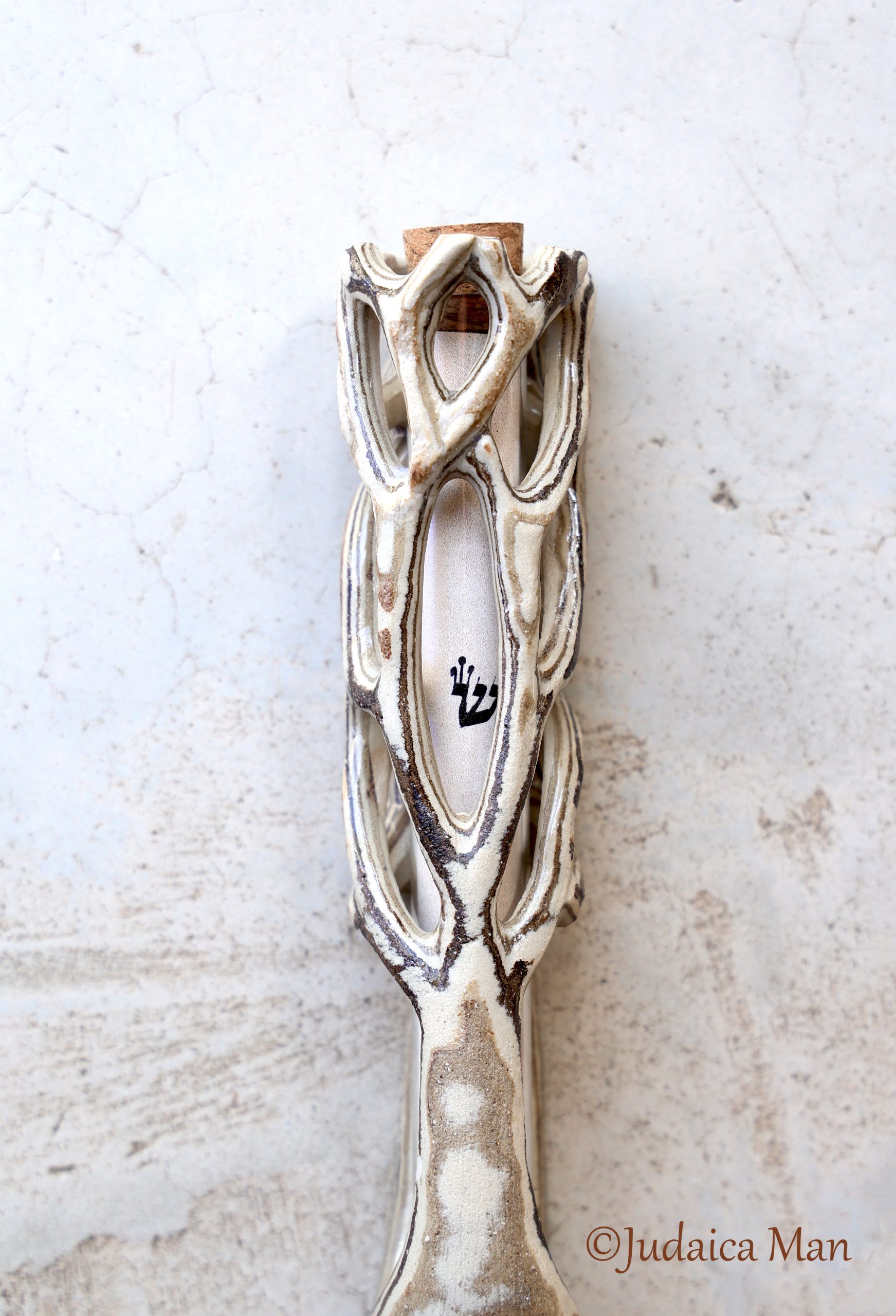
In the workshop of Judaica Man, every mezuzah case goes through a complete process. Design, shaping in clay, firing in a high-temperature kiln, hand painting, and sometimes real gold ornamentation. Each of these stages adds to the cost, but also gives the mezuzah case a presence that can’t be faked. The price of a designed mezuzah case reflects not only the material but the time and the hand of the artist. That is the difference between an object and something with a soul.
A handmade mezuzah case reflects working time and an artist’s skill, not just the cost of raw materials.
Does the mezuzah case affect kashrut?
Halachically, no. The scroll is the mitzvah, and the mezuzah case is only the covering. And the mitzvah is the scroll. A scroll wrapped in simple plastic is fully kosher even without any designed case. This is an important point to know, so that you don’t feel you have to spend a fortune on design in order to fulfill the mitzvah.
Still, the case has a real role in keeping a mezuzah kosher over time. A mezuzah case that isn’t sealed, that lets water in, or that isn’t insulated from the heat of the Israeli sun, like most mezuzah cases made of iron, for example, can destroy the scroll, either because it gets wet or because it burns. The letters get erased, the scroll warps, and a mezuzah that was kosher becomes invalid. So the mezuzah case doesn’t determine kashrut, but it does protect it. For an exterior mezuzah in particular, this is critical.
The scroll determines kashrut, but a quality, sealed mezuzah case is what preserves that kashrut over the years.
What’s the difference between a “mezuzah” and a “mezuzah scroll”?
This confusion is very common, and we run into it almost every week. People say “mezuzah” and sometimes mean the outer covering, and sometimes the scroll written inside. In everyday speech, “mezuzah” is everything that hangs on the doorpost. In practice, the true mezuzah is the scroll written by hand in ink, and the mezuzah case is the body that wraps it.
This distinction matters when you buy online or in a store. Always ask what’s included in the deal. Are you buying only a mezuzah case and need to purchase a scroll separately, or is it a complete package? Once you understand the difference, the first step is to choose, from a wide selection of mezuzah cases, the style that speaks to your heart and to your home’s design line, and only then match the scroll to it.
Before buying, it’s worth confirming explicitly whether the price includes only the mezuzah case or also the kosher scroll.
How do you know the scroll is kosher and not printed or invalid?
Let’s say it plainly: if you’ve seen a mezuzah scroll at a price that sounds too good to be true, on a fast international marketplace or in an unregulated market, that’s a warning sign. Often it’s a product printed by machine or a photocopy on paper, which is completely invalid for use. A kosher scroll must be handwritten by a certified scribe.
There are basic signs you can check yourself. On a genuine scroll you can see the ruling, the fine lines the scribe makes before writing in order to keep the lines straight. And the God-fearing scribe, or whoever sells the scroll, should hold a scribe’s certificate from a recognized institution approved by the Rabbinate. In any case, ask the seller for a certificate of kashrut. You can also ask your nearest Chabad house for help, and they can refer you to a certified, God-fearing scribe.
What to ask before buying
Three questions solve almost everything. Who is the scribe who wrote the scroll? Did the scroll go through a computer check in addition to a manual proofreading? And is there a kashrut certificate from a recognized body? A serious seller will be glad to answer. Anyone who dodges the answers is basically telling you they aren’t sure the scroll is kosher.
A printed or photocopied scroll is completely invalid for use, and only handwriting by a certified, God-fearing scribe confers kashrut.
What’s the difference between a “kosher” scroll and a “mehudar” (enhanced) one?
A kosher mezuzah is a mezuzah you can recite the blessing over. A mehudar mezuzah is a different level. Here we’re talking about visually stunning writing, clear and symmetrical letters, even spacing, and an especially fine scroll. This is “this is my God and I will beautify Him” in the fullest sense of the word, adorning the mitzvah with beauty. And whoever invests specifically in a mitzvah that ultimately nobody sees (because the scroll is rolled up with the writing facing inward) also sees an enormous blessing in their home that comes from a place hidden from the eye… and the wise will understand.
Why does it cost more? Because a scribe who is able to write in a mehudar script invests many times more time in each scroll, and his level of skill is far higher. There is great demand for work like this, and that is reflected in the mezuzah scroll price. Whoever buys a mehudar mezuzah isn’t buying only kashrut, but beauty that lasts for generations.
A mehudar script demands significantly more time and skill from the scribe, and that is reflected directly in the price of the scroll.
What size mezuzah scroll do you need?
Scroll sizes are measured by the height of the scroll in centimeters. The common ones are 10, 12, 15 and 20 cm, and sometimes, for synagogues or Chabad houses, 25 cm. There’s a small paradox here that surprises many: a particularly small scroll, such as 10 or even 8 cm, can actually be more expensive, because the scribe has to write microscopically and with extreme precision in a tiny space. That’s why we recommend sizes like these less, since they also become invalid quickly due to the density of the letters, and are also less mehudar. Sizes of 12 and 15 cm are considered the most popular and the easiest to write and to read.
How to match a scroll to an existing mezuzah case
This is the mistake we most want to prevent. If you already have a mezuzah case, don’t measure its outer height. Measure the free interior space, meaning the place where the scroll will actually lie. Make sure the scroll is smaller than the space by a centimeter or two, so that it won’t get crushed, warped, or folded when it’s inserted. A squeezed scroll is a scroll that may become invalid over time.
Always measure the interior space of the mezuzah case, not its outer height, and leave the scroll a margin of a centimeter or two.
How much do mezuzahs cost for a new home, and how do you calculate how many you need?
Anyone who moves into a new apartment or builds a home usually panics for a moment: how many mezuzahs do I even need? So first of all, not every doorway requires a mezuzah. The front door, the yard gates, the doorways of rooms and the kitchen require one, and sometimes hallways too. Showers, toilets, and very small rooms not meant for living are exempt, or are smaller than 2 meters in length and width. It’s always best to consult a rabbi so as not to buy an unnecessary scroll or, conversely, to end up one scroll short. You can consult, 24 hours a day except Shabbat, with the rabbis of the halacha hotline at *3030.
The formula we recommend to families is simple. Invest the nicer part of the budget in the front door, a designed and luxurious mezuzah case and a mehudar scroll, because this mezuzah is seen all day long and represents the character of the home, and the scroll at the entrance is the most important one. For the interior bedrooms you can choose more delicate and simpler mezuzah cases. That way mezuzahs for a new home become a balanced decision and not a budget headache. This is also why a handmade mezuzah case is a Jewish housewarming gift that stays in the memory.
It’s worth investing most of the budget in a designed mezuzah case and a mehudar scroll at the front door, and choosing simpler solutions for the interior rooms.
Why are there such big price gaps between mezuzahs?
The gap comes from several layers that build up one on top of another. First the scroll: mehudar versus basic, the script of an experienced scribe versus a trainee with a final sign-off by an expert, double proofreading versus a basic check. Second the mezuzah case: a mezuzah case created in a small workshop by hand, with an artist’s signature, is simply not like a mass-produced import made of thin plastic. In addition, each of our creations carries a different amount of thought and work time.
When you compare mezuzah prices, make sure you’re comparing apples to apples. Sometimes people look at a “mezuzah case only” versus a “kosher scroll” and think there’s an inexplicable gap, when in fact these are two completely different things. A designed mezuzah case’s price embodies material, time and skill. Once you understand that, the decision becomes much clearer.
Choice level
The scroll
The case
Best for
Level 1
Basic kosher
Functional, for protection
Limited budget
Level 2
Standard kosher
Designed and durable
A balance between the two
Level 3
Mehudar
Handmade ceramic for the entrance
Those who want a holy presence, protection and beauty
Level 4
Especially mehudar
Artistic sets for the whole home
Collectors and those investing in hiddur
When comparing mezuzah prices, it’s important to make sure the comparison includes exactly the same components, scroll against scroll and case against case.
How much does a mezuzah check cost, and when do you really need one?
A mezuzah check is a cost separate from the purchase, and it’s good to know about it in advance. The common custom is to check mezuzahs once every 3 years, and some are accustomed to checking every year in the month of Elul. Pricing is usually per scroll, at the scribe you bought from or at an authorized scribal institute. A check generally costs about 20 NIS per scroll.
There are circumstances that call for an urgent check even without a schedule. Moving into an apartment where the mezuzahs were hanging for many years. Moisture penetrating near the doorpost. Prolonged exposure of the doorpost to direct sun and heavy humidity. A check identifies fading, cracks, letters that were erased or stuck together, fully or partly, and weather damage before they become irreversible. A kosher mezuzah that is well looked after will serve you for many years.
Another reason for an urgent check that is well known in Judaism is, for example, a serious health problem or a disaster, heaven forbid. We’ve heard quite a few stories in the studio… each more surprising than the last. Like, for example, that of a young mother of children who suddenly fell ill with a condition in her legs, unable to stand. The doctors couldn’t cure it. Until her husband opened the mezuzah case at the entrance to the house and discovered that the holy scroll had been put in upside down, and immediately exclaimed: “So that’s why my life is upside down!”
A mezuzah is worth checking once every 3 years, and more often if it is exposed to moisture or direct sun, or if a sudden problem arises in the family, heaven forbid.
Which mezuzah case suits an outdoor doorway?
The front door is completely exposed. Heavy rain in winter, scorching sun in summer, and in between, simply humidity. A scroll placed in an unsuitable case at a doorway like this can be ruined in a relatively short time, and that’s a shame, because this is supposed to be the most mehudar mezuzah in the house.
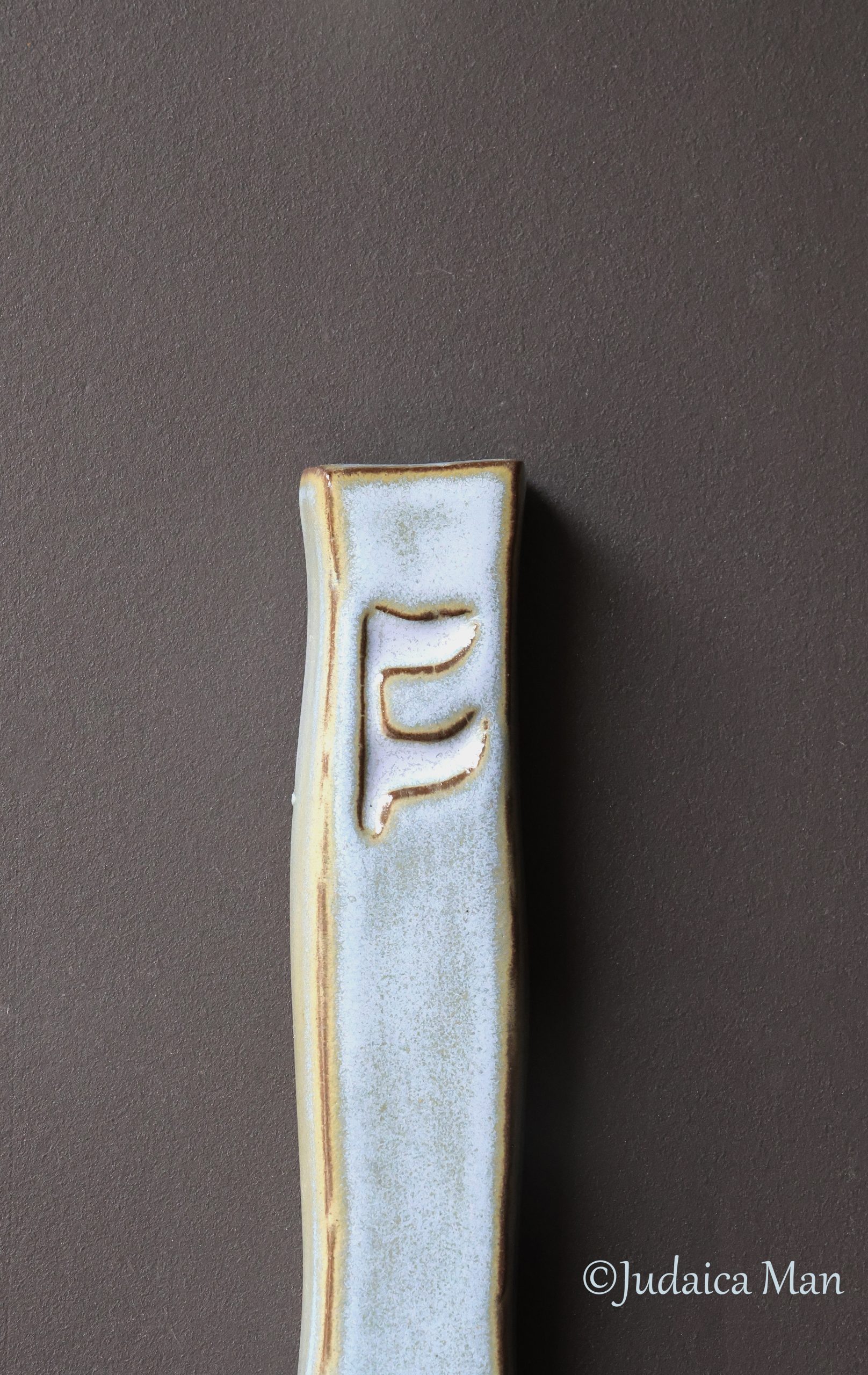
For outdoors we recommend materials that don’t rust and don’t warp. Quality ceramic that has been fired at a high temperature is an excellent choice, because it allows excellent sealing and protection from harmful UV radiation. And yes, even outside you’re allowed to choose something beautiful. A mezuzah case can be both durable and a piece of art that makes everyone who arrives pause for a moment at the doorway.
For an exterior doorway exposed to rain and sun, quality ceramic fired at a high temperature offers better durability and better protection for the scroll than other materials.
Can you buy a beautiful mezuzah case and add a scroll separately?
Absolutely yes, and it’s a way we love very much. It gives you complete flexibility. You choose the design that speaks to you from the artist you love, and at the same time purchase the scroll through a certified, God-fearing scribe or a recognized scribal institute, according to your family’s halachic customs and stringencies.
That way a couple who wanted a ceramic mezuzah case with gold ornamentation for the entrance can combine it with a mehudar scroll they chose separately. The mezuzah case and the scroll don’t have to come from the same place. What matters is that they match in size. If you’d like something custom for your occasion, we’re always open to a conversation on WhatsApp 052-338-3094 (from international +972523383094) or by email at info@judaicaman.com.
You can choose a designed mezuzah case and complete it with a scroll from a separate scribe, as long as the sizes match.
What should you buy first, the scroll or the mezuzah case?
Our recommendation is clear: it’s easier to match a scroll to a mezuzah case than the other way around. Especially if you’ve fallen for a designed mezuzah case with unusual dimensions, which not every scroll will fit into. So first choose the mezuzah case, check its interior dimensions, and only then order the scroll in the exact size that fits the space.
The opposite mistake, a scroll that was bought first and turns out to be too big for the mezuzah case you loved, is frustrating. You find yourself either cramming the scroll in, which may damage it, or giving up the mezuzah case you wanted. The right order saves you all that. A designed mezuzah case’s price is much more worthwhile when it’s chosen first and guides the selection.
It’s best to always choose the mezuzah case first and measure its interior space, and only then order the scroll in the matching size.
More Products Worth Knowing
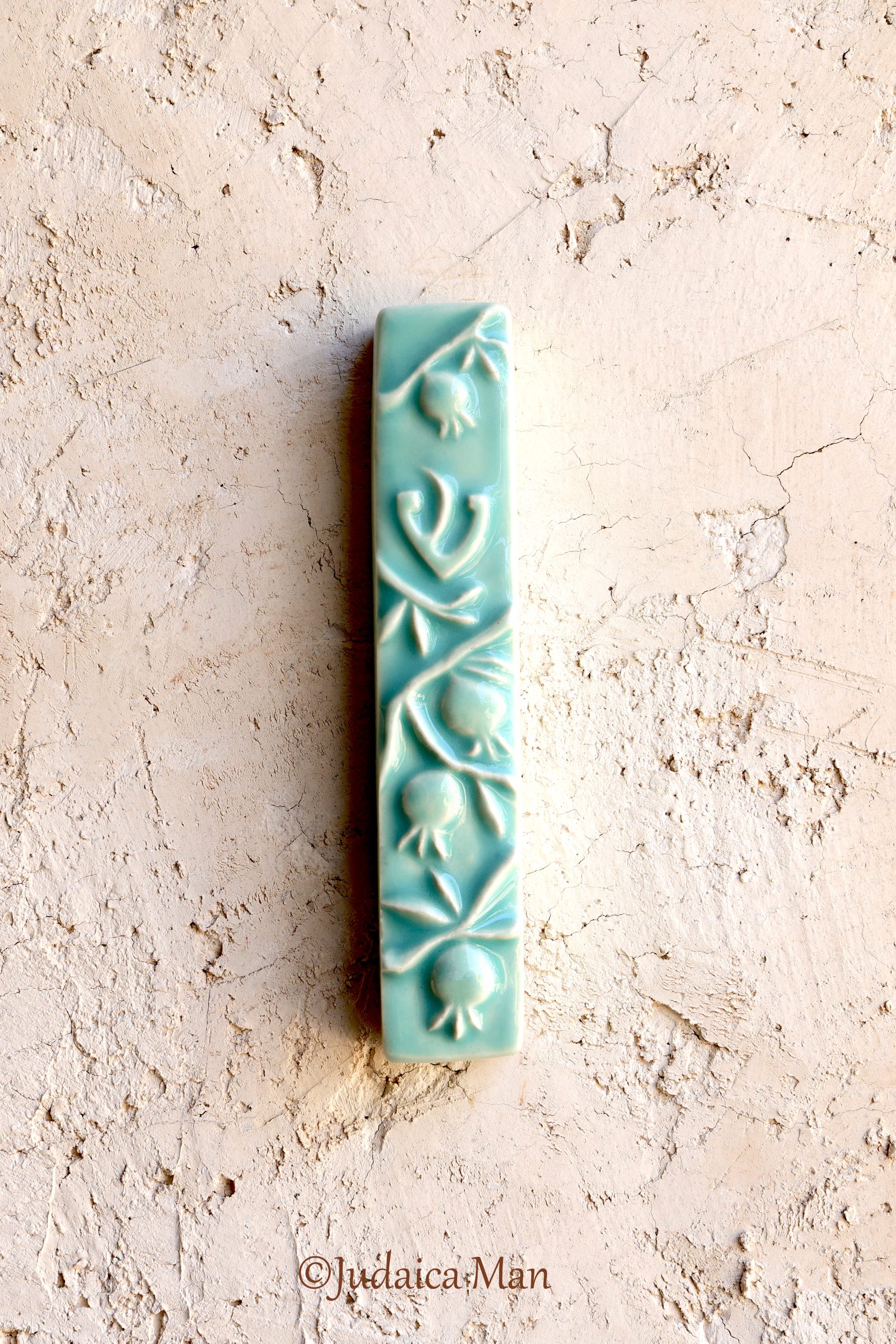
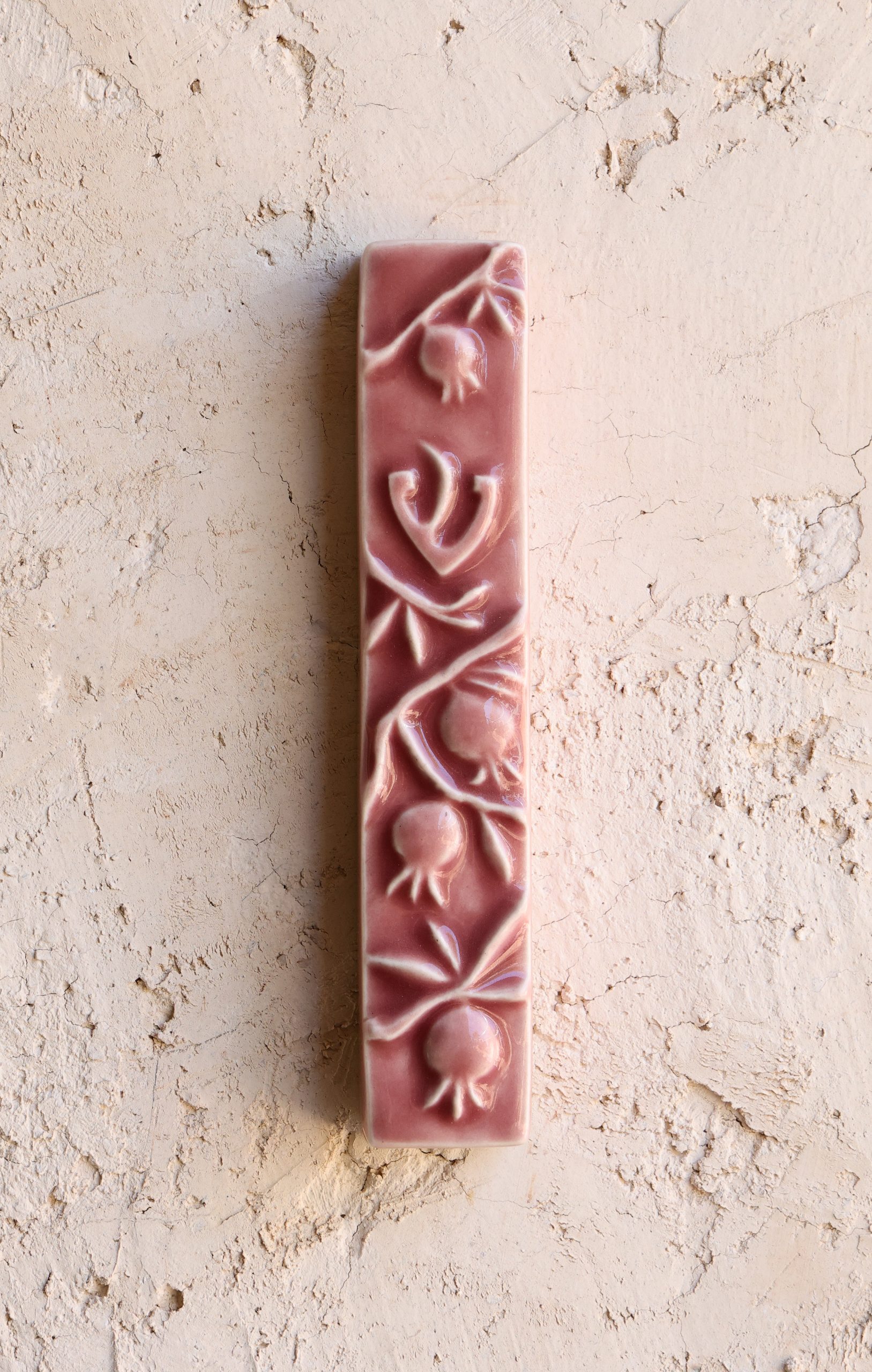
Pomegranates Mezuzah Case, “Fresh” Series, Forest Green
Does the mezuzah case have to be completely sealed?
There is no halachic requirement for a complete seal indoors, but outdoors, to prevent moisture, water and pests that could invalidate the scroll from getting in, it is strongly recommended to seal the edges or choose a well-protected case, especially for exterior doorways. Otherwise the scroll may become invalid without you even noticing…
Why does a mezuzah scroll sometimes cost more than the mezuzah case?
The scroll is written by hand by a scribe, work that demands many hours of meticulous writing, special ink, and halachic quality control. The mezuzah case, despite its aesthetic importance, can sometimes be simple and faster to produce.
Is there a price difference between types of script?
Yes. Ari script, Beit Yosef script, or Sephardi script require different levels of skill and time from the scribe, and that directly affects the final price of the scroll.
How often is it recommended to check the mezuzah?
Twice in three years. Mezuzahs installed outdoors and exposed to sun and humidity should be checked more often, to make sure they haven’t been damaged.
A good mezuzah is built from two parts, both of which deserve thought: a kosher scroll written by hand, and a mezuzah case that protects it and represents your home. At Judaica Man we’re here to help you find the right combination, for any budget and any style.