
A week before the wedding, a WhatsApp message lands in our inbox: “Hi, we’re getting married this coming Tuesday, can we get a hand-painted ketubah with artistic calligraphy?” We read it, smile, and explain to the client that handwork takes time, then start thinking about what we can actually do to help this couple. The real answer is that calligraphy and gold ornamentation don’t dry on the venue’s schedule. They dry on their own schedule. And that’s exactly the point.
In this article you’ll find
- Exactly when to start ordering a ketubah to avoid unnecessary stress
- The difference between a printed, designed, and hand-painted ketubah — in time, materials, and cost
- Which personal and halachic details must be finalized before printing/creating the ketubah
- How to choose the right community text (nusach) and match the design to the couple’s character and home
- What to do if a mistake is discovered, and how to preserve and frame the ketubah for years to come
Table of Contents
- When should you order a ketubah before the wedding, and how do you start right?
- How long does it take to prepare a ketubah (printed vs. hand-painted)?
- Does the rabbi provide a ketubah, or do you need to order one independently?
- Which details must be finalized before placing a ketubah order?
- How do you choose the ketubah text according to community and custom?
- What’s the difference between a printed, a designed, and a hand-painted ketubah?
- How do you choose a ketubah design that fits the couple’s character and the home’s décor?
- Step-by-step guide: what does ordering a ketubah online look like?
- What should you do when you receive the ketubah?
- Can you order a ketubah urgently, at the last minute?
- Combining translation and a bilingual text (Hebrew and English/other languages)
- What should you prepare for the ketubah-signing ceremony on the wedding day?
- Preserving, conserving, and framing the ketubah as a keepsake for years to come
- How much does it cost to order a ketubah, and what factors affect the price?
- Fitting the ketubah order into a full wedding timeline
Featured Products
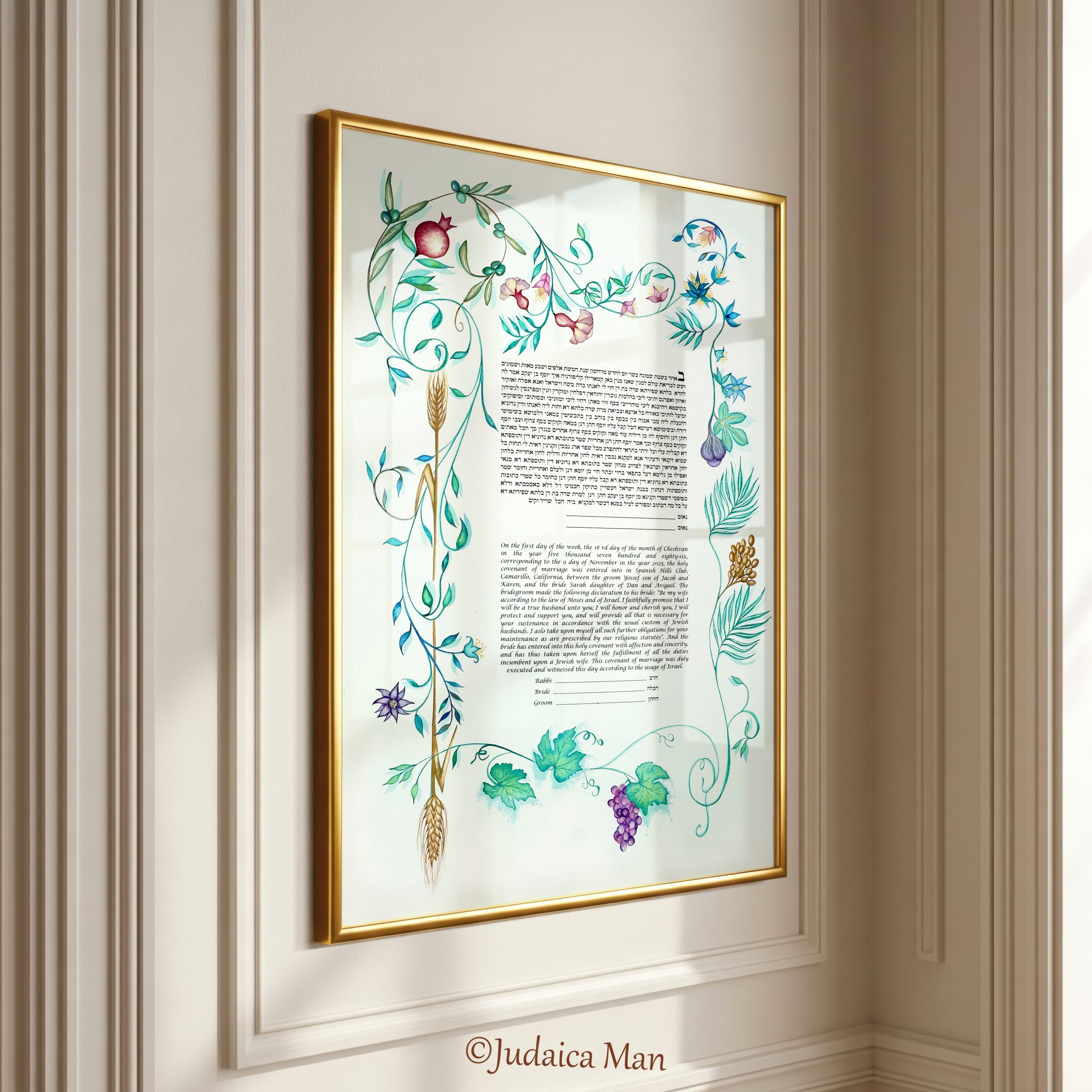
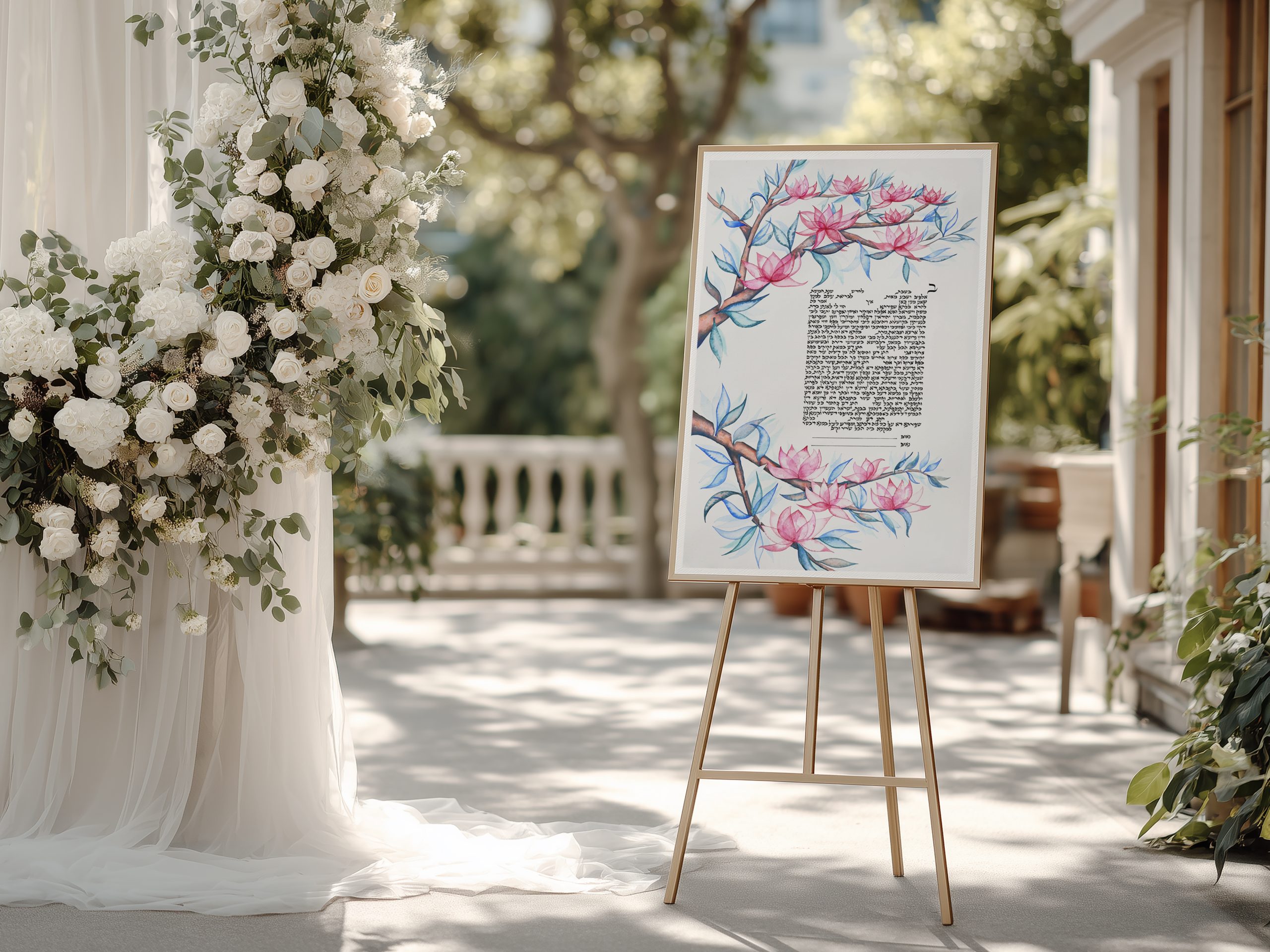
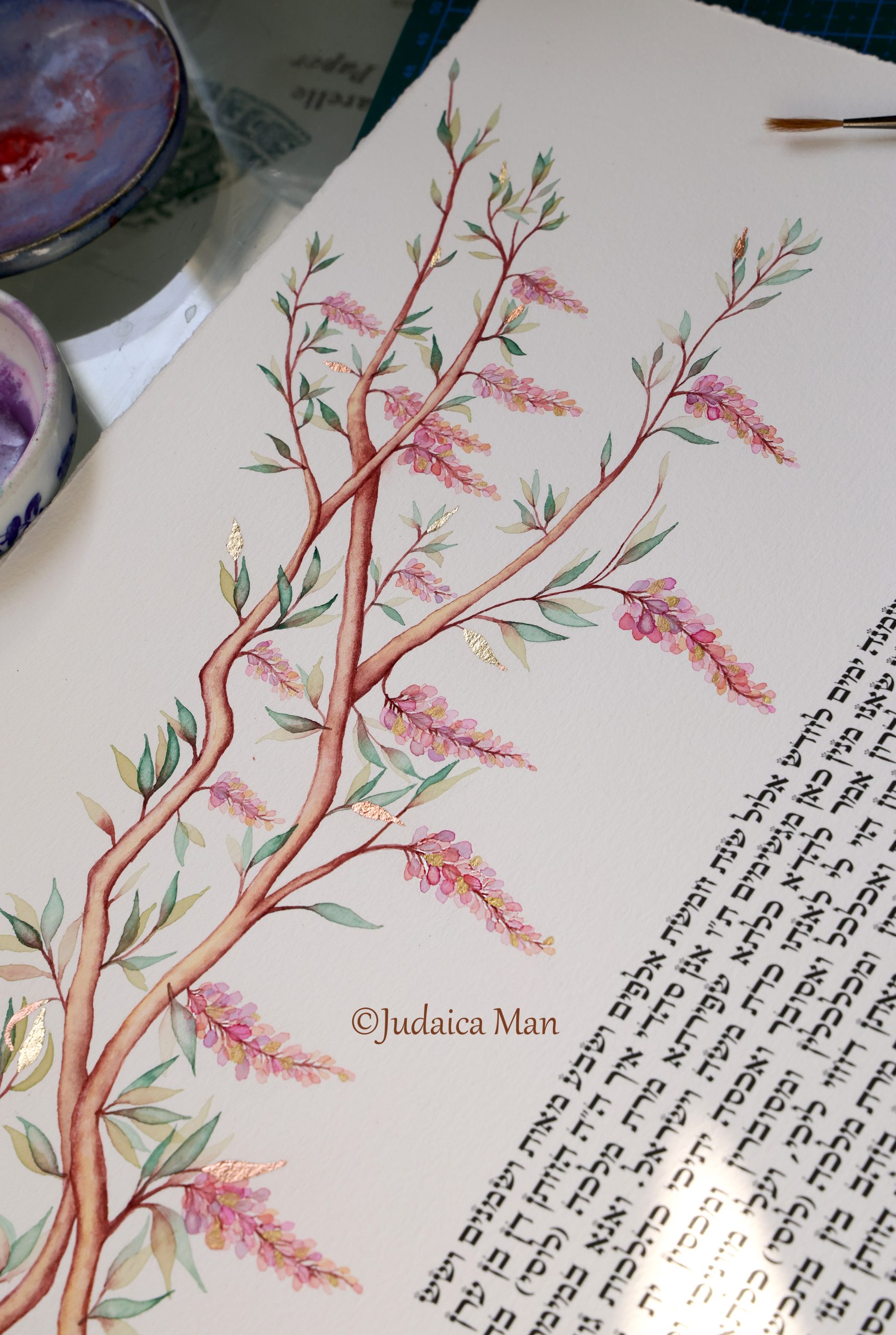
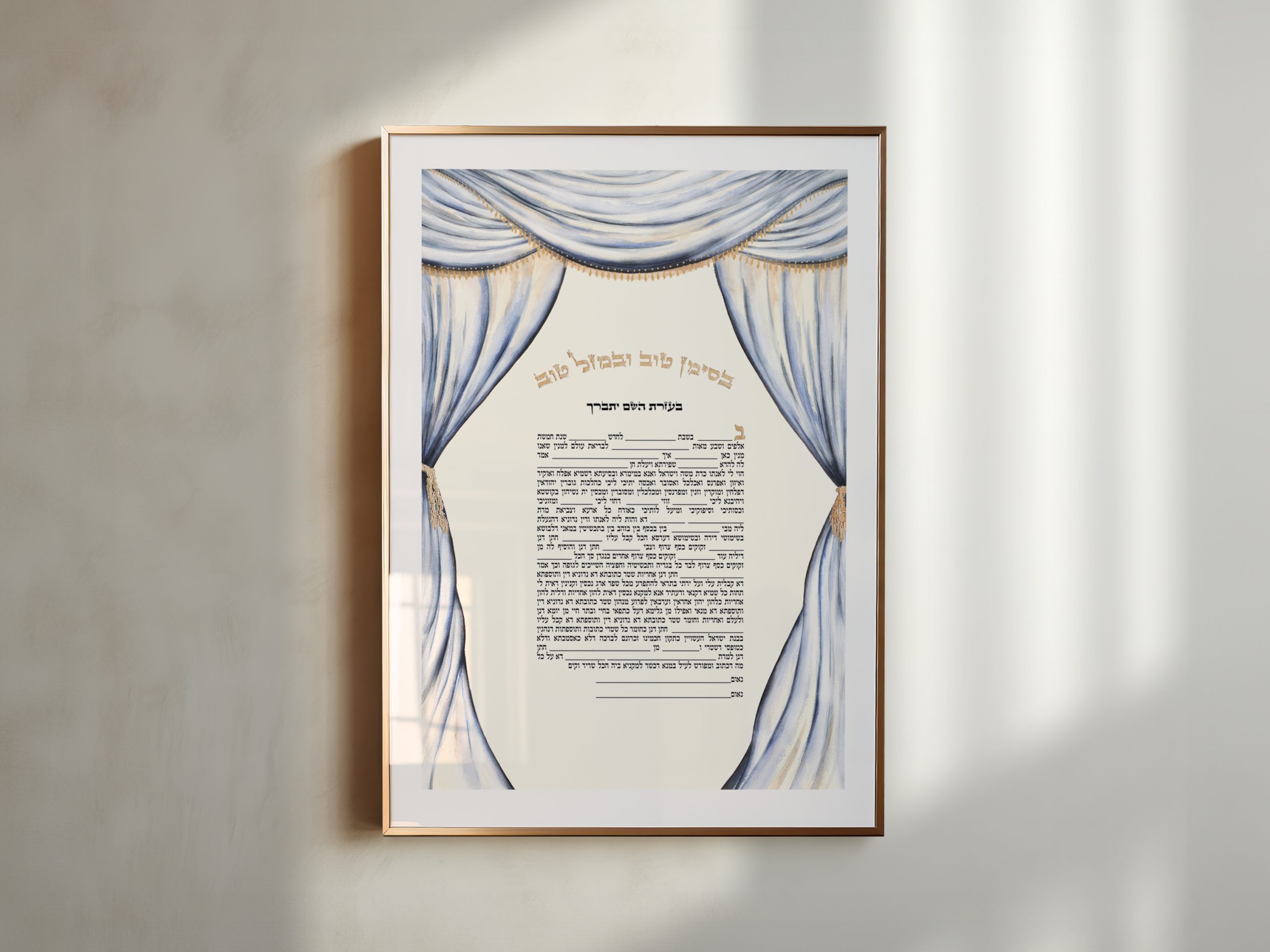
When should you order a ketubah before the wedding, and how do you start right?
The ketubah is a halachic-legal document signed before witnesses, and it’s also the only piece from the wedding that will hang on your wall for decades afterward. These two facts together determine the timing.
Our rule of thumb for every couple who calls is 6 to 10 weeks before the wedding for a standard ketubah, and 8 to 12 weeks for a custom piece with an original illustration or a special text. This isn’t a range we invented to sound serious. It’s the actual time it takes to finalize the text with the rabbi, sketch it out, make corrections, paint it, let the color dry properly, and ship it.
What happens when you order late? The whole situation gets rushed, and there’s no time for repeated checks or adjusting the ketubah to unexpected changes — for example: names — you find out too late that the bride’s father’s name is spelled differently on the ID card, that no one checked whether the chuppah is before or after sunset, or that the rabbi is actually abroad for two weeks and unavailable for proofreading.
Our simplest tip: the moment you’ve booked a venue and a wedding date, write “ketubah” on a note next to the photographer line item. It belongs on the wedding timeline just like any other vendor.
How long does it take to prepare a ketubah (printed vs. hand-painted)?
A ketubah printed on quality fine art paper leaves the studio within a few days to two weeks, depending on workload and how quickly you complete proofreading. A hand-painted ketubah is a completely different story — between eight and twelve weeks of actual work, and sometimes more.
This gap isn’t bureaucracy. It comes from the fact that watercolor needs to dry between layers, that 24-karat gold ornamentation is applied by hand and requires patience, that inspiration and creation need calm, and that good artistic Hebrew calligraphy is written in one long, unhurried sitting — not between phone calls.
There’s another factor worth knowing: wedding season. In spring and summer, and in the weeks after Lag BaOmer and after Tu B’Av, the studio’s worktable is full. During those months we sometimes book orders three months in advance. In winter, the pressure drops significantly.
| Stage | Printed Ketubah | Hand-Painted Ketubah |
|---|---|---|
| Consultation and model selection | 1-2 days | 3-7 days |
| Gathering details and proofreading | 3-5 days | 5-10 days |
| Execution (printing / illustration and calligraphy) | 1-3 days | 2-10 weeks |
| Drying and curing | Not applicable | 2-5 days |
| Quality control, packaging, and shipping | 2-4 days | 3-5 days |
The key production stages that affect the timeline
Our process is fixed: consultation and model selection, gathering details and choosing the text, sketch and proofreading, artistic execution, quality control and packaging. The stage that tends to drag on the most for couples is actually proofreading, because it depends on you and your rabbi, not on us. Give it a full week in the timeline. Not two days.
Does the rabbi provide a ketubah, or do you need to order one independently?
A question that comes up with a lot of clients. The answer is yes — in most cases, the officiating rabbi or the rabbinate’s office will bring a standard printed ketubah form: a plain sheet with blank fields to fill in.
But that’s office paper. Not something you’d hang in the living room.
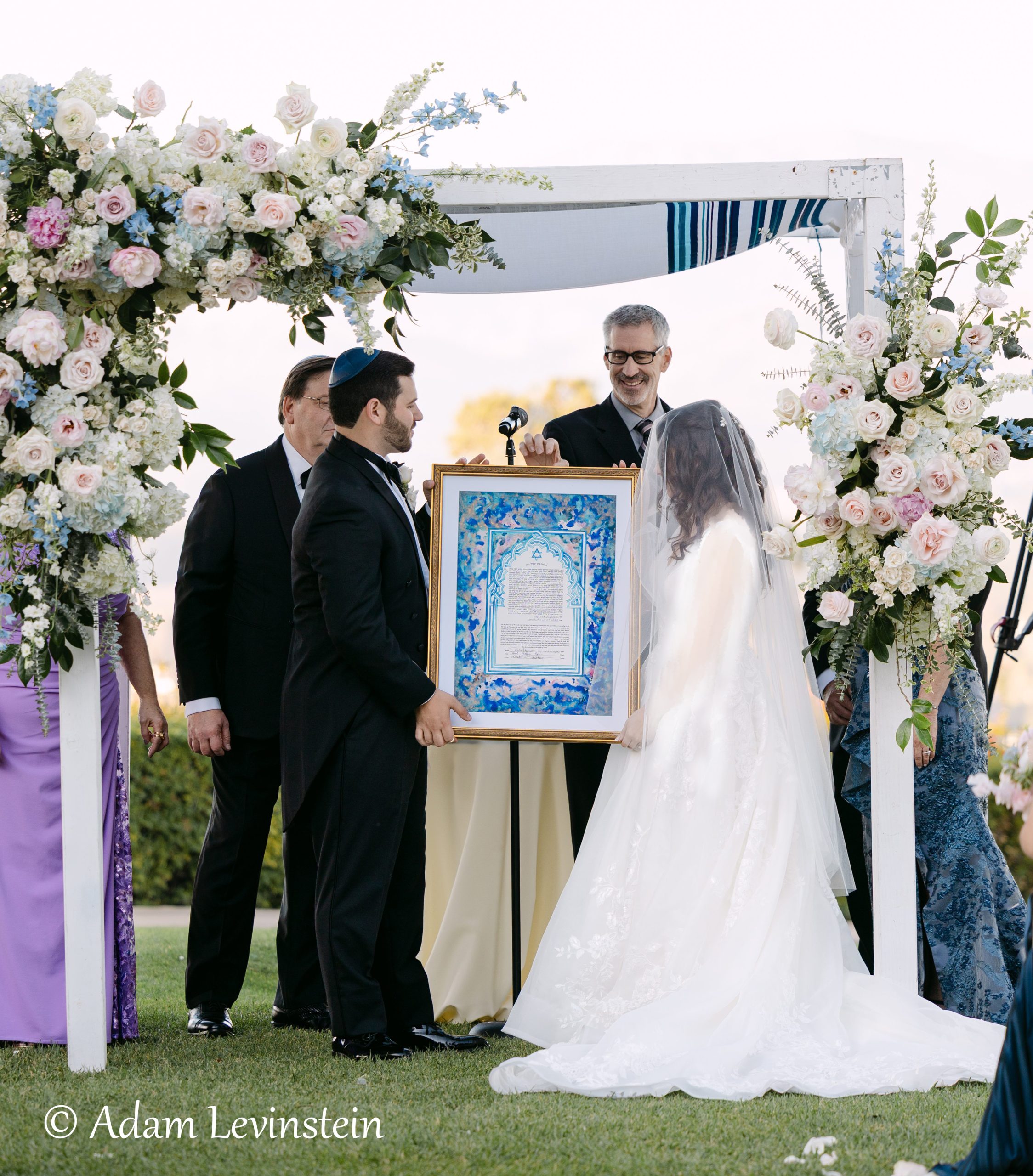
There’s no halachic requirement to use that specific form. You’re allowed to bring your own designed ketubah, on one simple condition: that the text is halachically accurate, that there’s proper, clear space left for signatures, and that the officiating rabbi has seen and approved it in advance. Almost every rabbi we’ve met is happy to see a couple who invested in their ketubah. It’s a good sign for investing in the marriage going forward…
What do you gain from ordering a designed ketubah from an artist? A document that’s also a work of art, personal customization, and a design you love and are excited to hang in your home, plus a shared experience of choosing it together as a couple. Our pieces are made to remind you of this moment for the rest of your lives. The couples we work with are always so happy to see progress photos of the piece they chose — those are moments when they connect with us to the world of inspiration, creation, art, and the calm, pleasant moments of preparing for the wedding.
Which details must be finalized before placing a ketubah order?
Every reprint, and every calligraphic correction, starts with one detail the bride and groom didn’t check. One letter in a name, a venue that changed at the last minute…
Two points people almost always miss. The first is spelling the name in Hebrew according to family tradition rather than however is convenient to write — for example, Sarah vs. Sari, Yaakov vs. Yankel. The second, and this one is critical: if the chuppah takes place after sunset, the Hebrew date on the ketubah is already the next day’s date. Or even more so — postponing the chuppah to another time for various natural or personal reasons. That’s why, at Judaica Man, we always recommend leaving the name and date lines blank and letting the officiating rabbi fill them in at the chuppah.
Checklist of details to gather before filling out the order form
Before you fill out a designed ketubah order form or give us the details, gather in one place: the groom’s full name including his father’s name, the bride’s full name including her father’s name, each person’s halachic status (single, divorced, widow, Kohen, Levi), the civil date, the exact Hebrew date matching the time of the chuppah, the city and venue name spelled out in full, and the requested community text (nusach). Send this list to your rabbi before sending it to us. And best of all — ask the officiating rabbi to send you the full ketubah text himself.
How do you choose the ketubah text according to community and custom?
The main texts we write are: the traditional Ashkenazi text (Nachalat Shiv’ah), the traditional Sephardic/Eastern-communities text of Rabbi Eliyahu Bar Shalom, and the Tzohar organization’s text.
Before we started designing ketubot, we spent about three months studying the halachot of the ketubah and the differences between the various texts, and made sure to verify them with Rabbi Daniel Cohen for Ashkenazim and Rabbi Yosef Chaim Chaba for Sephardim, so that every letter and comma would be exactly right.
Even if grandpa was from Casablanca, the officiating rabbi is the one who knows which text he uses for your chuppah. One phone call to him saves two weeks of corrections.
What’s the difference between a printed, a designed, and a hand-painted ketubah?
Three categories, and people mix them up constantly.
A printed designed ketubah is a high-quality artistic print using specialty pigments that faithfully reproduce the original artwork, known as giclée. The printing is done at a print house specializing in fine art, at museum-grade quality. The paper is fine-art stock roughly 310gsm, 100% cotton, acid-free. You can choose from a range of fonts we offer for the text. Hand-applied gold, copper, or silver accents can be added depending on the design.
A custom hand-painted designed ketubah is one single, one-of-a-kind original piece. Hand-painted watercolor, Hebrew calligraphy written letter by letter, 24-karat gold or gold-tone ornamentation, copper, silver… on 100% cotton, acid-free fine art paper roughly 310gsm. This ketubah is an original work of art, and there is no other one like it in the world — even for a couple ordering the exact same design. You can order a custom-designed ketubah with printed text surrounded by hand-painted illustration (a more accessible price point), or a custom-designed ketubah with text written entirely in artistic calligraphy from start to finish.
| Parameter | Printed Design | Custom Hand-Painted Design | |
|---|---|---|---|
| Uniqueness | Identical between orders | One-of-a-kind personal design | |
| Production time | Days to weeks, depending on hand-applied gold, copper, or silver accents. | 3-12 weeks | |
| Materials | Museum-quality, 100% cotton, acid-free fine art paper, roughly 310gsm. Real or imitation gold, silver, copper. | Museum-quality, 100% cotton, acid-free watercolor paper, roughly 310gsm. Real or imitation gold, silver, copper. Paints from France, Japan… | |
| Suitable for tight timelines | Very | No | |
| Value as an art piece | Medium | High |
How do you choose a ketubah design that fits the couple’s character and the home’s décor?
The ketubah used to be kept in a case in the bookshelf. Today it hangs in the living room or above the entryway console, and it’s often the most personal item on the wall of the home.
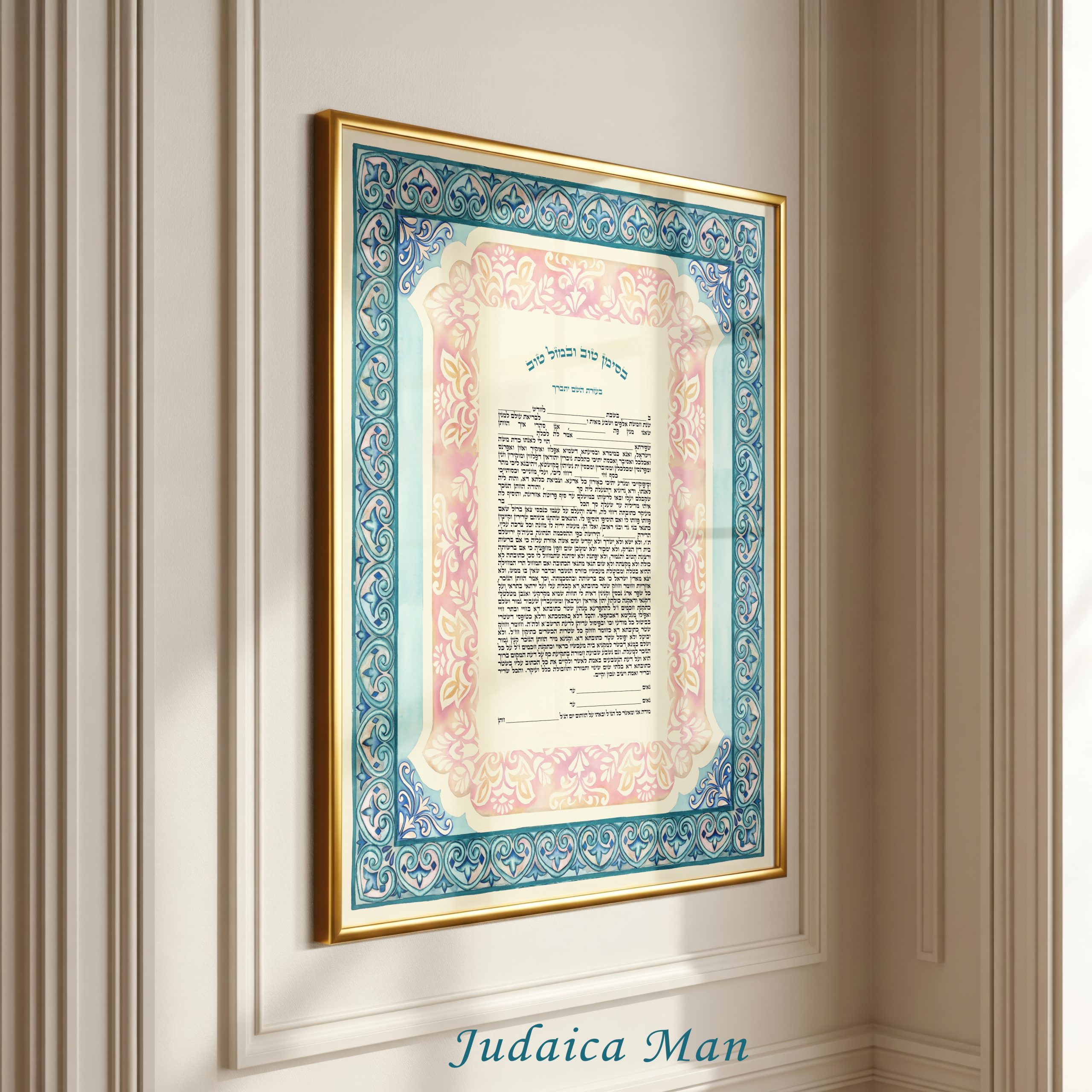
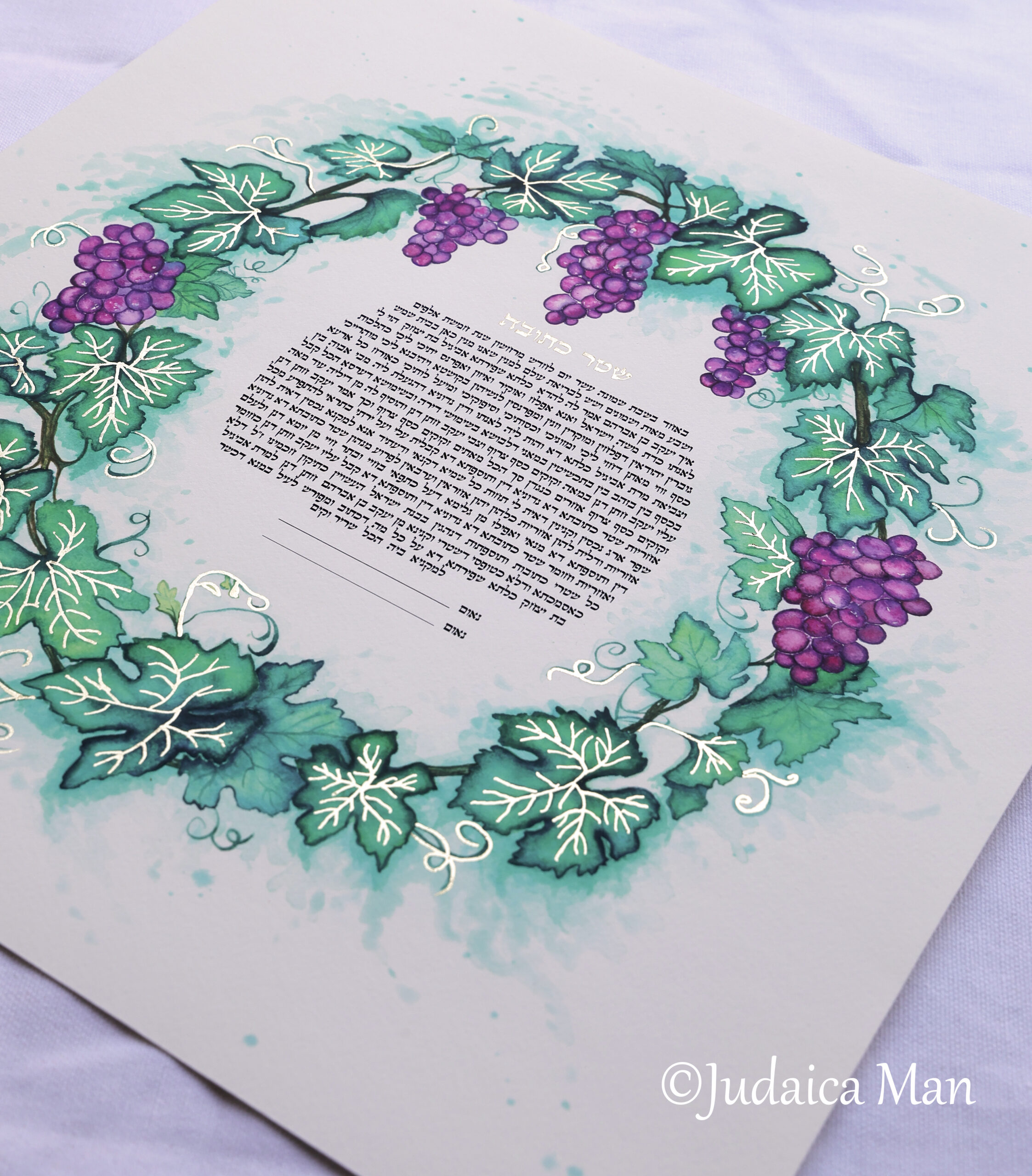
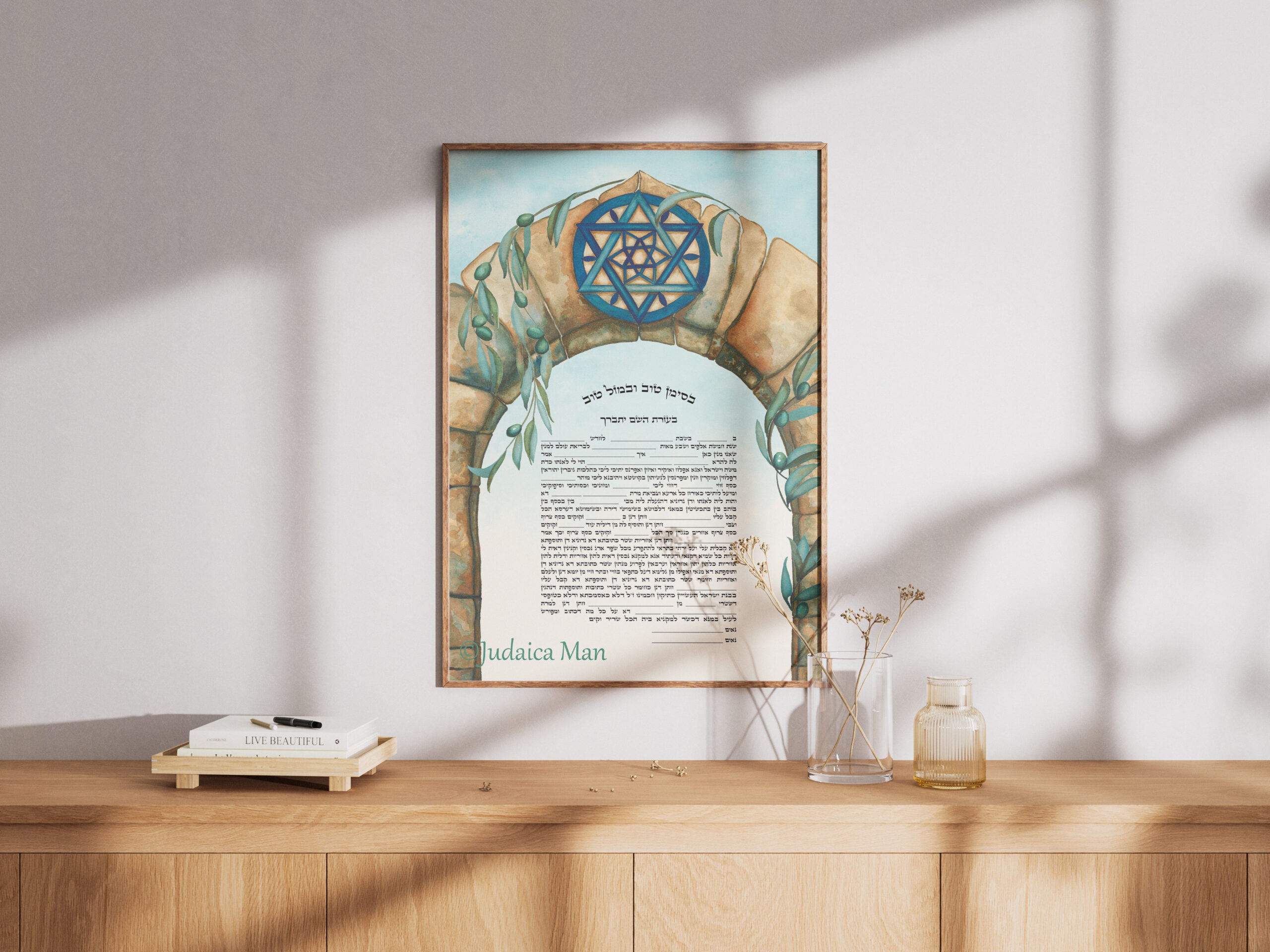
The styles we work in broadly fall into three categories. Classic-traditional: Jerusalem landscapes, the Seven Species, free-form illustration. Modern-minimalist: geometric shapes, clean typography, plenty of white space. Botanical-natural: wildflowers of the land, olive branches, soft watercolor.
Designing a ketubah requires a lot of skill and experience. For example, for a couple who bought a renovated Arab-style house in Jaffa with stone walls and dark furniture, we’d advise different colors than for a couple planning to live in a modern building in Ramat Gan. This is so that the ketubah looks, on one hand, as if it’s always belonged in their home, and on the other hand, fits with the wedding’s atmosphere as one cohesive whole.
If you already have candlesticks, a mezuzah, or a seder plate you love, or a floral design for the wedding and chuppah, send us a photo. We match tones so that the pieces in your home and at the wedding speak to each other instead of competing.
Common mistakes in choosing size, colors, and fonts
The first mistake is a font that’s too dense and decorative. Remember, the rabbi and witnesses need to read this in the groom’s room, sometimes in dim lighting and always under time pressure. The second mistake is an unusual size that’s hard to frame. Stick to sizes like 35×45 or 50×40 cm, and you’ll thank us when you get to the framer.
Step-by-step guide: what does ordering a ketubah online look like?
We know that ordering remotely is stressful, especially for our clients in Paris, London, or New York who can’t just pop into the studio. So here’s exactly how it works for us, no surprises.
Step one: you choose a model and style from the pieces on our site, or tell us what you have in mind. Step two: you send us all the details from the checklist above. Step three: we prepare a digital sketch of the text and send it to you, and you pass it on to the officiating rabbi. Step four: final written approval of the sketch. Step five: execution, drying, quality control, and insured shipping to your door. If the ketubah is ordered too close to the wedding date (and we’ve confirmed it’s feasible), a special same-day courier fee may be added.
Note one important point: the moment you approve the sketch, we begin painting or send it to print, depending on your choice. A change after that isn’t always possible at all, and if it is possible, it comes with a cost. Review the sketch twice before you approve it.
What should you do when you receive the ketubah?
First, take a breath 🙂 As soon as the package arrives, gently open it from the sides with a Japanese utility knife, without pushing it in — be careful. Read the enclosed instructions for signing, framing, and preserving the ketubah. Buy the special pen with archival ink that we recommend for signing, as noted in the instructions, so there’s no ink bleeding into the ketubah’s special cotton paper.
Can you order a ketubah urgently, at the last minute?
You can, and it entirely depends on what you’re willing to give up and on our availability.
A ready-made design available for printing can leave the studio within 5 business days, assuming the text is finalized and the details are accurate. A last-minute hand-painted ketubah is a whole different, complicated story that requires personal coordination, and sometimes we simply have to tell the couple the truth: we won’t make it in time.
If you’re under real time pressure, three pieces of advice. Give up on a custom-designed ketubah and choose an existing model instead. Finalize the text with your rabbi that same day — not “we’ll check and get back to you.” And if you’re in Israel, you’ll need to add a fee for special courier delivery.
Combining translation and a bilingual text (Hebrew and English/other languages)
Many of our couples come from families that don’t read Hebrew. A grandmother from the UK or an uncle from Brooklyn will stand in front of the ketubah wanting to understand what it says.
The halachically permitted structure is the Aramaic-Hebrew text in the center and primary position, with the English or French translation sitting beneath it.
Layout principles to avoid visual clutter in a bilingual ketubah
Two texts on one sheet of paper tend to look cramped and disproportionate to the design. The solution is to increase the paper size, not shrink the lettering. Keep margins wide enough for the witnesses’ signatures, generous line spacing, and a clear visual separation between the sections. A ketubah that looks crowded will still look crowded on the wall twenty years from now.
What should you prepare for the ketubah-signing ceremony on the wedding day?
On the day itself, you won’t be thinking about this. So think about it now.
Appoint one responsible person — a coordinator, a sibling, a close friend — who holds the ketubah and brings it to the venue. Not the mother, who has a hundred other things on her mind that morning.
Prepare two archival pens, the kind recommended in the instructions that came with the ketubah, that don’t smear and aren’t acidic. A cheap ballpoint pen can smear on cotton paper and ruin weeks of work. Make sure there’s a clean, hard writing surface in the groom’s room, since a table covered in bottles and plates is not a place to sign on. Also place a sheet of paper under the witnesses’ hands so they don’t smudge the writing during the signing.
And immediately after the chuppah, before the dancing, the ketubah goes back into its rigid protective folder. Wine gets spilled, people hug, and one crease never comes out.
Preserving, conserving, and framing the ketubah as a keepsake for years to come
After all this work, it’s worth investing in framing too. We ask every couple to pass along two requirements to their framer.
First, UV-protective glass wherever the ketubah is hung. Watercolor and natural pigments fade slowly under light, and that process is irreversible. Second, acid-free matting. If there’s gold on the piece, we recommend framing with a mat so there’s no direct contact between the glass and the gold or watercolor, which over the years causes sticking and staining.
As for placement, keep it away from direct sunlight, not facing an open window, not above a radiator, and not on a damp exterior wall. A shaded interior wall is the best home it can have.
How much does it cost to order a ketubah, and what factors affect the price?
Let’s be upfront about it. In our studio, a ketubah printed on fine art paper sits at the accessible end of the scale; a fully hand-painted, designed ketubah with calligraphy and gold ornamentation is the premium category. The gap between them is mainly a gap in hours of work.
What actually drives the price up? Using real 24-karat gold leaf versus a gold-toned paint. An original illustration built from scratch around a personal story versus an existing design. Hand calligraphy for the entire text. A bilingual text that doubles the writing hours. And urgency in the timeline.
We always tell couples: everything else at the wedding is over by midnight. The ketubah stays. If there’s one place worth investing a bit more in, this is it.
Fitting the ketubah order into a full wedding timeline
The right way to plan is backward from the date, not forward from today. Here’s what that looks like when done right.
Recommended countdown timeline
3-4 months before: look at styles, gather inspiration, decide whether you want printed or hand-painted. First consultation call with us.
2-3 months (8-12 weeks) before: place the actual ketubah order and coordinate the text with the officiating rabbi. This is the critical point in the whole wedding timeline.
6-10 weeks before: approve the final sketch in writing, and the work moves into production.
2-3 weeks before: the ketubah arrives home. A thorough proofread of every letter, then flat, safe storage.
Wedding week: prepare a signing kit with two pigment pens and a hard surface, and decide who’s responsible for bringing the ketubah to the venue.
More Products Worth Knowing
Frequently Asked Questions About Ordering a Ketubah
A Final Word from the Studio
Here at Judaica Man, we combine craftsmanship, painting, and sculpture alongside illustration, watercolor, and calligraphy, and traditional work with precious metals meant for ornamentation, like real 24-karat gold or 925 silver. Every piece is made in our workshop by hand, from the idea to the gold finishing touches. Israeli craftsmanship, from start to finish.
If you have a date and you’re not sure you’re on schedule for your ketubah, just message us on WhatsApp at 052-338-3094 or by email at info@judaicaman.com. We’ll tell you the truth, even if the answer is that you should choose something else. We ship throughout Israel and abroad through the most reliable business courier services to Europe, London, the U.S., and France.
May you merit to build a faithful home in Israel and live together in love, joy, and ever-growing abundance until 120!