
On Friday evening, once the candles are already lit and the table is set, when the husband comes home from prayer, there is a small moment where everyone stands before Kiddush and the whole house seems to breathe. In our studio we meet many couples and families looking for exactly that moment. They want the exact Eshet Chayil words, clean and precise, to read aloud together facing the mother, the wife, and the family table. On this page we’ve gathered the full text of Eshet Chayil (Woman of Valor), along with its source, its meaning, and the way these verses live inside a Jewish home. Because Eshet Chayil is not just a text that’s read — it’s a clear declaration to the lady of the house, who is likened to the holy Shechinah.
In this article you’ll find
- What are the words of Eshet Chayil?
- What is “Eshet Chayil” and the secret of its power
- Who wrote Eshet Chayil and which book is it from?
- Why and when is “Eshet Chayil” sung on Friday night?
- Interpretation of the verse “Eshet Chayil mi yimtza”
- What do the lesser-known verses mean?
Table of contents
- What are the words of Eshet Chayil?
- What is “Eshet Chayil” and the secret of its power
- Who wrote Eshet Chayil and which book is it from?
- Why and when is “Eshet Chayil” sung on Friday night?
- Interpretation of the verse “Eshet Chayil mi yimtza”
- What do the lesser-known verses mean?
- A song for a woman, or a deeper allegory?
- A common mistake: is it a Psalm?
- How do we translate Eshet Chayil into today’s language?
- Why is Eshet Chayil so fitting for the home and as a gift?
- What should you choose: text alone, or a piece for your home?
Featured products
What are the words of Eshet Chayil?
A woman of valor, who can find? For her price is far above rubies.
The heart of her husband trusts safely in her, and he shall have no lack of gain.
She does him good, and not evil, all the days of her life.
She seeks wool and flax, and works willingly with her hands.
She is like the merchant ships; she brings her food from far away.
She rises also while it is yet night, and gives food to her household, and a portion to her maidens.
She considers a field and buys it; with the fruit of her hands she plants a vineyard.
She girds her loins with strength, and strengthens her arms.
She perceives that her merchandise is good; her candle does not go out by night.
She lays her hands to the spindle, and her hands hold the distaff.
She stretches out her hand to the poor; yes, she reaches out her hands to the needy.
She is not afraid of the snow for her household, for all her household are clothed in scarlet.
She makes herself coverings of tapestry; her clothing is silk and purple.
Her husband is known in the gates, when he sits among the elders of the land.
She makes fine linen, and sells it, and delivers girdles to the merchant.
Strength and honor are her clothing, and she shall rejoice in time to come.
She opens her mouth with wisdom, and in her tongue is the law of kindness.
She looks well to the ways of her household, and does not eat the bread of idleness.
Her children rise up, and call her blessed; her husband also, and he praises her.
Many daughters have done virtuously, but you excel them all.
Charm is deceitful, and beauty is vain, but a woman who fears the LORD, she shall be praised.
Give her the fruit of her hands, and let her own works praise her in the gates.
These are the twenty-two verses that a husband sings to his wife, and to the holy Shechinah, every Friday evening before Shabbat Kiddush. The text comes from the holy Torah, in the Book of Proverbs, chapter 31, verses 10 through 31. The reading is meant to bring calm, peace, love, and warmth into the home. When we sing Eshet Chayil, we receive the added measure of soul that comes with Shabbat — our “neshamah yeteirah,” the additional soul.
What is “Eshet Chayil” and the secret of its power
The word “chayil” surprises quite a few people. The mind jumps straight to an army, to force, to physical might. But in Biblical Hebrew, “chayil” is far broader than that. It is inner wealth and strength, life wisdom, practical capability, integrity and justice, and also the skill to run an entire household. A woman of chayil is a woman who manages a complex reality with wisdom and love, rather than with brute force.
So the figure that emerges from the poem is not one specific woman but a model of inner strength. She buys a field, plants a vineyard, trades, opens her hand to the poor, and at the same time her candle does not go out at night — much like the Shabbat candles of Sarah and Rivkah, which stayed lit from one Shabbat to the next. Looking at this psalm as a complete hymn of praise, as described on Chabad.org, helps us understand why it gives so much strength. It reminds every household that these values are not to be taken for granted, and that whoever lives by them lives a truly meaningful life.
Who wrote Eshet Chayil and which book is it from?
The psalm is an inseparable part of the Jewish bookshelf, taken from Eshet Chayil in the Book of Proverbs (Mishlei), chapter 31, which closes the entire book. According to Jewish tradition, King Solomon composed the Book of Proverbs, and these lines were written as a letter of praise and appreciation. Some sages explain that he wrote them about his mother, Batsheva the righteous, wife of King David. Other sages saw in them an allegory for the Torah and wisdom, and others saw a reference to the Shechinah, the Divine Presence.
Eshet Chayil is built as an alphabetical acrostic — each verse opens with the next letter of the Hebrew alphabet. Twenty-two letters, twenty-two verses. This order is not accidental. It conveys completeness, harmony, and the timelessness of the God-fearing Jewish woman.
The custom of singing Eshet Chayil around the table took shape and spread mainly in the days of the Kabbalists of Safed. Picture Friday night: the candles have been lit, the father and children have returned from synagogue, and everyone stands around the set table. This hymn is a moment of appreciation for the mother of the family, for the woman, for everything she did throughout the week. It comes right after “Shalom Aleichem” and before the Kiddush over the wine.
The psalm also carries deep kabbalistic layers. In the tradition of the Safed kabbalists, it connects the woman to the holy Shechinah and to welcoming Shabbat as a “bride.” You can read more about this connection in the article on why and to whom Eshet Chayil is sung on Friday night, on Chabad.org. Rebbe Nachman of Breslov writes in Likutei Moharan, Part I, teaching 203, that from the conversations of women one can perceive the state of the Shechinah — how it is currently faring. Rebbe Nachman drew this from the verse in the Book of Esther about Mordechai, who would walk about in front of the court of the women’s house to learn of Esther’s welfare, and explains that Esther corresponded to the holy Shechinah, and that Mordechai learned of her “welfare” through speaking with her. The Shechinah is the presence of the King (the Creator of the world) within the palace (the world). The Shechinah accompanies the people of Israel at every moment, and can, God forbid, also withdraw temporarily at certain times — such as moments of anger and hatred. At moments of love and brotherhood, the Shechinah rests among us, and we suddenly feel calm and contentment. From the Book of Esther, Rebbe Nachman understood that by listening to even the simplest conversations of women, one can sense the general state of the Shechinah — whether she is grieving or rejoicing. Rebbe Nachman teaches that a person’s speech — in this case, the Jewish woman’s — reflects reality, and the Jewish man, like the righteous Mordechai, understands from it what is required of him at that moment.
The connection between the psalm and the Shabbat table
This hymn carries the household from the everyday into the sacred, settling everyone into calm just before Kiddush and the meal. It is part of that same domestic sequence that unfolds as Shabbat begins — the candles, the prayer, the Kiddush, and the Shabbat songs. The Eshet Chayil psalm comes to connect our added soul with the Jewish woman who prepared and labored in honor of Shabbat, and with the peace of this holy day. Our sages explain that Shabbat is far more than simply a weekly day of rest — it is a day of rest for both soul and body. It is a day on which we gather spiritual and physical strength for the whole week ahead. It is a day on which we, so to speak, remarry the Holy One and the holy Torah.
That is precisely one of the reasons Shabbat is so precious to us that we decided our website and studio would also be closed on that day, as noted on our Shabbat & Holiday collection, because for us Shabbat is not merely a design theme. It is part of life itself.
Interpretation of the verse “Eshet Chayil mi yimtza”
This is the best-known verse in the psalm, and not by chance. “A woman of valor, who can find? For her price is far above rubies.” The word for “her price” here refers to her spiritual worth. The verse compares the woman’s value to precious stones and rare pearls, and says that she is worth even more than they are.
The point is that it is not easy to find a woman with such inner values. Whoever merits her has found a true treasure, far more precious than any material possession. Here is a declaration of deep honor and love that depends on nothing external.
When a man is blessed to marry such a precious woman, he must guard her as a treasure of pearls (which were once as valuable as gold) and honor her with all his strength — even, as he pledged in the ketubah at his wedding, “more than his own body.”
What do the lesser-known verses mean?
Some of the expressions in the psalm sound archaic to a modern ear. Here are a few of them, in plain language.
“And he shall have no lack of gain”
The line “the heart of her husband trusts safely in her, and he shall have no lack of gain” explains that a God-fearing woman is trusted by her husband — he loves and values her — and thanks to the love and trust found in her home, abundance is always present too. When a couple reaches this level, they will lack nothing. Blessing in livelihood is not measured in quantity, but in joy. We can see very wealthy people with successful careers but no joy at all, and, conversely, very poor people who are joyful with whatever they have, as though living in the king’s own palace. This is the blessing that the “Eshet Chayil” brings to her husband and to her whole household — they build a Jewish home of calm, love, and joy, where blessing rests on their livelihood and on everything their hands do. And everything they earn comes from a kosher, pure place, and brings with it happiness and joy. And they enjoy every shekel they earn. These are the ways of faith in the Creator of the world — that if we treat one another, first of all at home, with love and respect, out of a life of purity and holiness, we merit endless light of contentment, and are happy with all we have — and even with what we don’t have!
“She perceives that her merchandise is good”
One holy commentator explains this verse to mean that the soul which “tastes” the sweetness of mitzvot and good deeds — her “merchandise” — understands that these are her true, everlasting profit, for all generations. And the light will always appear precisely in the moment of darkness — “her candle does not go out by night” — and it will never disappear. Our father Abraham sang Eshet Chayil for Sarah on the day of her eulogy, because she revealed to the world the “taste” of the mitzvot.
Regarding Chana, the mother of the prophet Samuel, the Midrash says: “‘She perceives that her merchandise is good’ — this is Chana, who tasted the taste of prayer.” Chana waited years for children and was not blessed with them. One day she came to the Mishkan in Shiloh to pray silently for children — “her lips moved but her voice was not heard.” At the time it was not customary to pray silently, and the priest thought she was drunk. When Chana explained that she was not drunk but was praying quietly, out of modesty, so that people would not hear her, other interpretations explain that a person’s quiet voice is heard by the Creator no less than a prayer spoken aloud — for He “searches the heart and mind.” Eli the Priest apologized for having suspected her, and blessed her that her prayer be answered. And indeed she was blessed, and merited to bring the prophet Samuel into the world. And it was from the righteous Chana that we learned the silent Amidah prayer that we recite three times a day. Thanks to Chana we learn that prayer from the depths of the heart is the most precious “merchandise” of the people of Israel.
A Jewish woman knows how to manage her steps wisely, and sees that her actions bear fruit for the benefit of all.
“And the law of kindness is on her tongue”
What is “Torat chesed,” the law of kindness? It is Torah that is not merely studied like an encyclopedia, but Torah that is put into practice through good deeds and kindness — Torah learned in order to teach. This is “Torat chayim,” a living Torah.
The Torah in its entirety is kindness, and the Jewish woman has her own natural, unique way of passing it on gently and sweetly to the members of her household. The Torah was given first to the women and only then to the men — why? Because only a woman knows how to hand it down to her children in a way that will take root sweetly in their hearts, and so continue the lineage of the whole people of Israel.
A song for a woman, or a deeper allegory?
Throughout the generations, commentators have divided into two main approaches. The simple approach sees Eshet Chayil as a hymn of praise for the actual woman of the house, for the labor of her hands, her wisdom, and her fear of Heaven. The allegorical approach sees it as a parable for loftier spiritual matters: a representation of the Shechinah, a symbol of Divine wisdom, or a broad image of the Torah itself, which grants protection and abundance to those who keep it.
Interestingly, in the tradition of our sages, Ruth the Moabite is considered the concrete embodiment of “Eshet Chayil,” thanks to her extraordinary acts of kindness and the kindness shown to her in accepting her as a convert into the people of Israel despite her being a Moabite. Ruth’s entire conduct throughout her life symbolizes kindness toward others — toward her mother-in-law, with whom she remained, together with her husband Boaz… Rabbi Ze’ira said: “This scroll contains no [law of] purity or impurity, no prohibition or permission. Why, then, was it written? To teach you how great is the reward of those who perform acts of kindness” (Ruth Rabbah [Vilna] 2:14).
It was precisely Ruth the convert who merited to become the great-grandmother of King David, from whom the Messiah will descend.
Just as we love delving into the layers of Biblical texts, you can read more on the subjects of Jewish tradition and art in the latest articles on our blog.
A common mistake: is it a chapter in Psalms?
No — and this is a very common mistake. Many people associate beloved hymns with the Book of Psalms, likely because of the musical character of the Psalms. But Eshet Chayil is not a Psalm. It is chapter 31 of the Book of Proverbs.
The difference isn’t only technical. The Book of Psalms deals mainly with personal prayers, cries to the Creator, and direct praises of God. The Book of Proverbs is wisdom literature — practical, moral guidance for Torah-based living. Eshet Chayil sits exactly there, at the heart of wisdom literature, and so it is a description of a character and of values — not a prayer.
How do we translate Eshet Chayil into today’s language?
On one hand, beauty is not disqualified — the Torah itself mentions the beauty of the matriarchs, such as Rachel, Avigail, Esther, and Sarah, or of King David, “beautiful of eyes.” Our soul loves beautiful things. But when is beauty considered “false”? When it does not match what’s within. When beauty serves “a woman who fears the Lord,” it serves the good. The verse comes to teach us that it is inner beauty that radiates outward, and that this is the woman’s true strength. A woman who is rooted in her inner beauty carries the beauty that will last for generations, and it is that true beauty which shows outwardly, visible to all. “Fear of the Lord” is the ability to reveal the inner strengths we’ve inherited from our holy matriarchs — strengths of faith, self-sacrifice, and modesty — which are the only eternal beauty that never fades.
The bottom line of Eshet Chayil sums it all up: “Charm is deceitful, and beauty is vain, but a woman who fears the LORD, she shall be praised.” Outer beauty fades. What remains is character, values, kindness of heart, the soul. Perhaps that’s why this verse continues to move people, precisely in an age where so much attention goes to the external.
Why is Eshet Chayil so fitting for the home and as a gift?
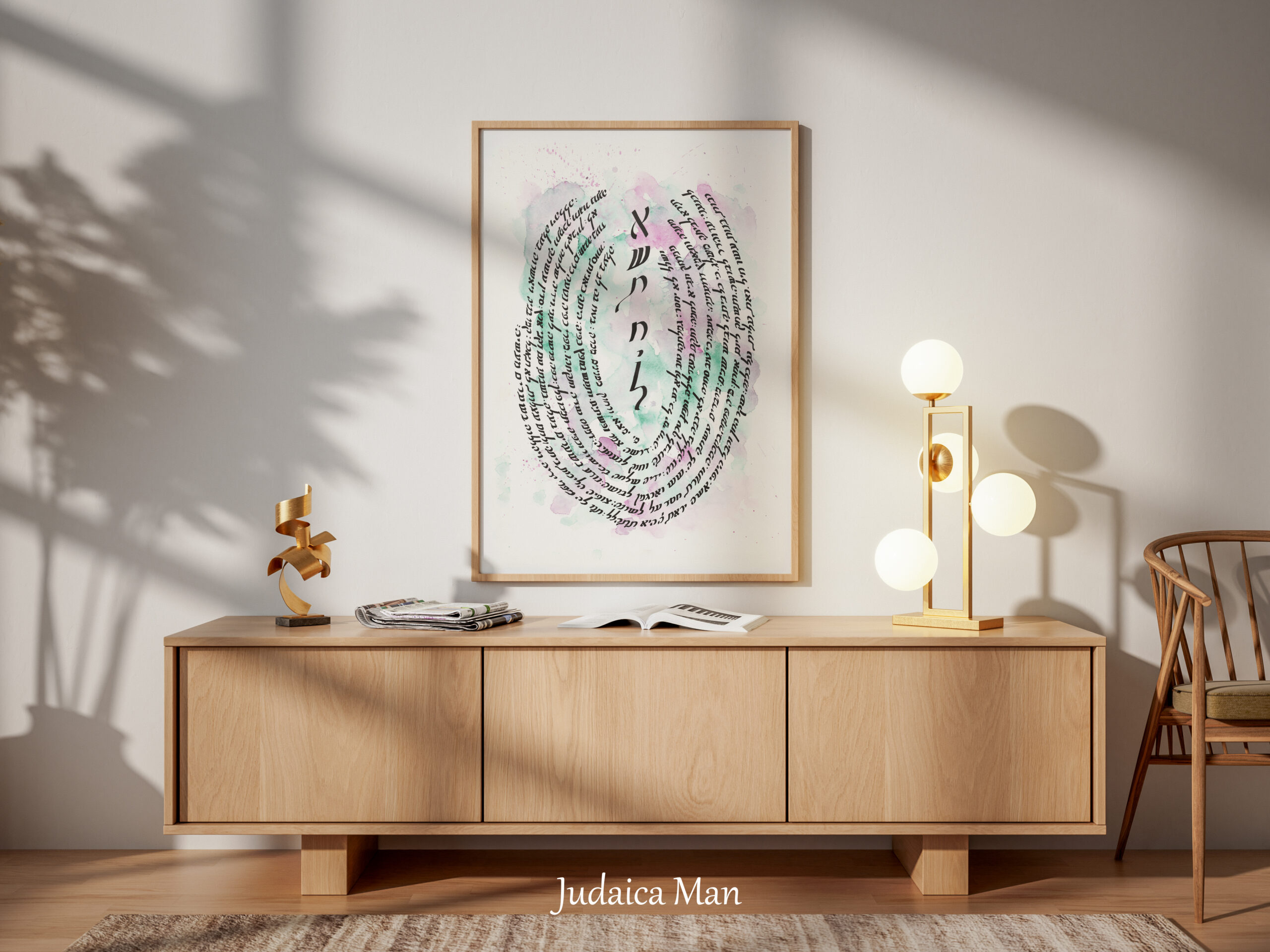
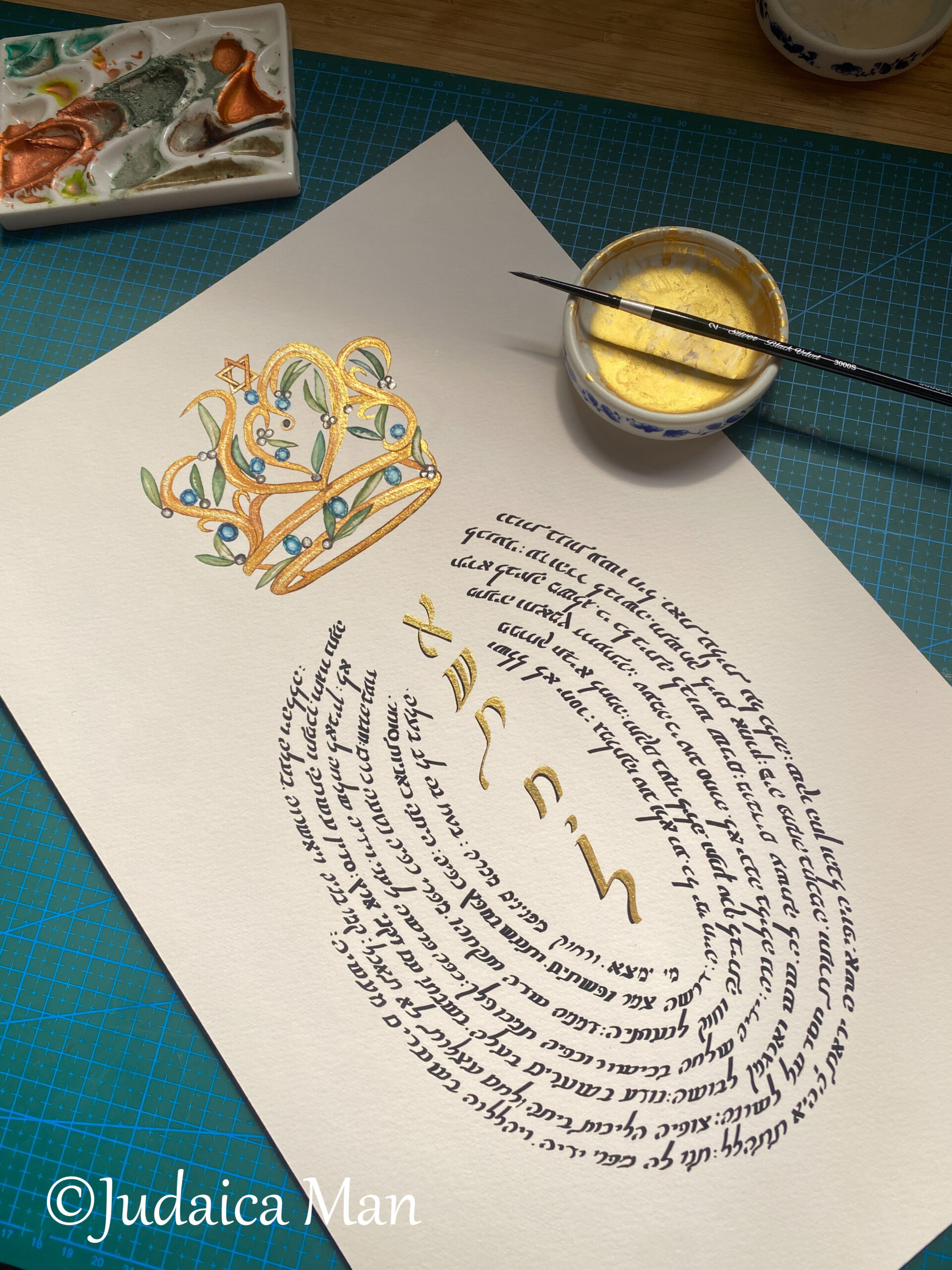
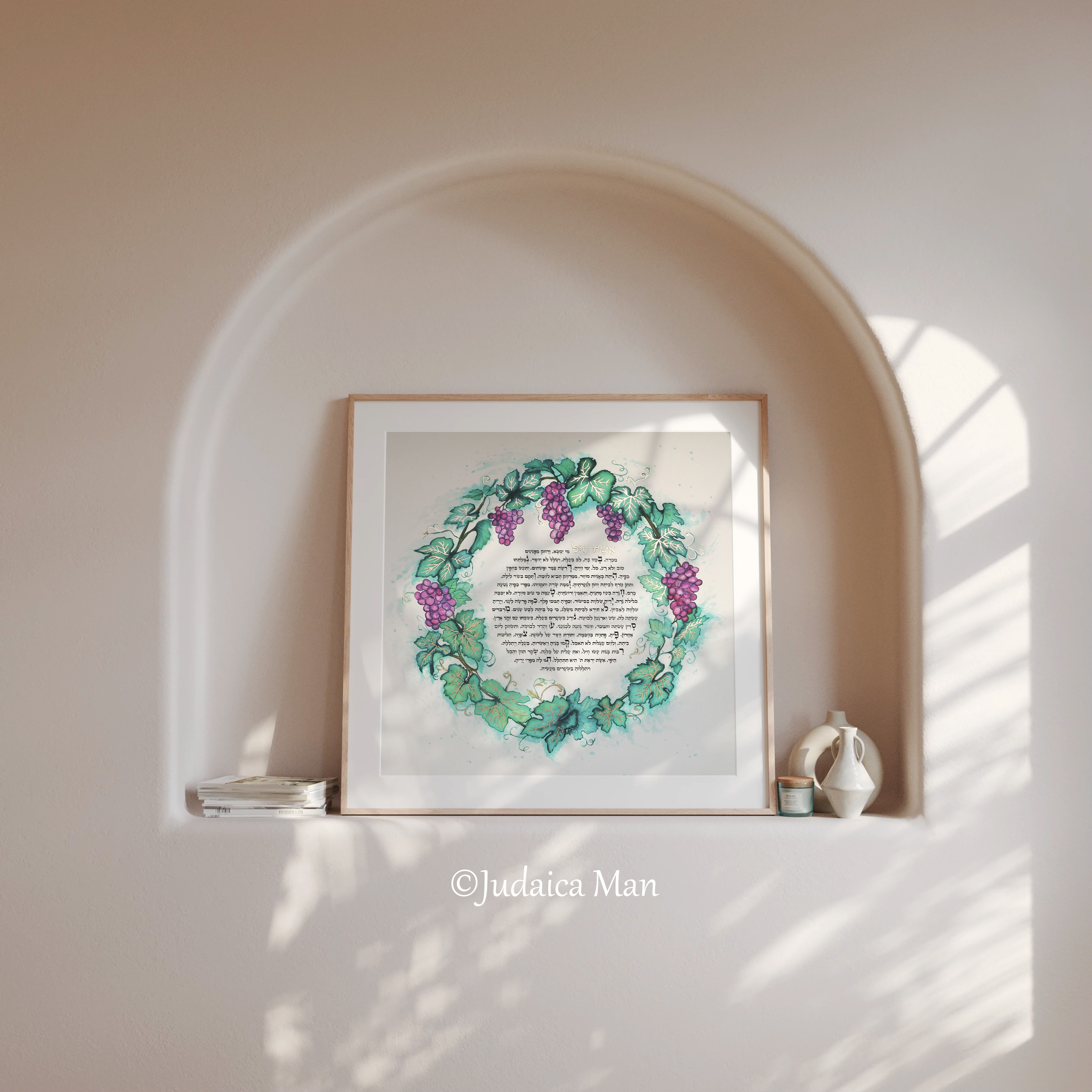
This is where our world comes in. In the workshop, we see how alive this text becomes once it turns into a piece of wall art. Hand-crafted Hebrew calligraphy, delicate watercolor, and sometimes 24-karat gold leaf detailing give the words of Eshet Chayil a quiet presence in the room. It is not decoration. It is a daily reminder.
A piece like this is a natural choice for occasions built around appreciation: a bridal gift for a wedding, a moving gift for a mother, a designed sign for a housewarming, or a warm gesture for a beloved wife. Many people choose a single verse, such as “and you have risen above them all” or “and the law of kindness is on her tongue,” and ask for a personal dedication alongside it. Handmade artwork carries that advantage: you can match the tone, the style, the exact wording.
At Judaica Man, a boutique studio run by the couple Asaf and Levia Man, every piece is handmade, from concept to finish. If you’d like to see what’s currently available, you’re welcome to visit the studio’s Jewish art and calligraphy shop. And if you’d like something entirely unique, with your own design and dedication, feel free to contact the studio and we’ll plan the right piece together. WhatsApp +972-52-338-3094 or info@judaicaman.com.
What should you choose: text alone, or a piece for your home?
Many people aren’t sure exactly what they’re looking for around this psalm. Here’s a summary.
| What you’re looking for | Best for | What you get |
|---|---|---|
| Full, vowelized text | Reading it on Friday night | The exact words for reading at home |
| Text with interpretation | Wanting to understand it too | Clarity on difficult Biblical phrases |
| A single verse for a dedication | Looking for a focused gift | A personal, warm message on jewelry or artwork |
| Handmade calligraphy artwork | A wedding, housewarming, or gift for a mother | An artistic piece that lasts for generations |